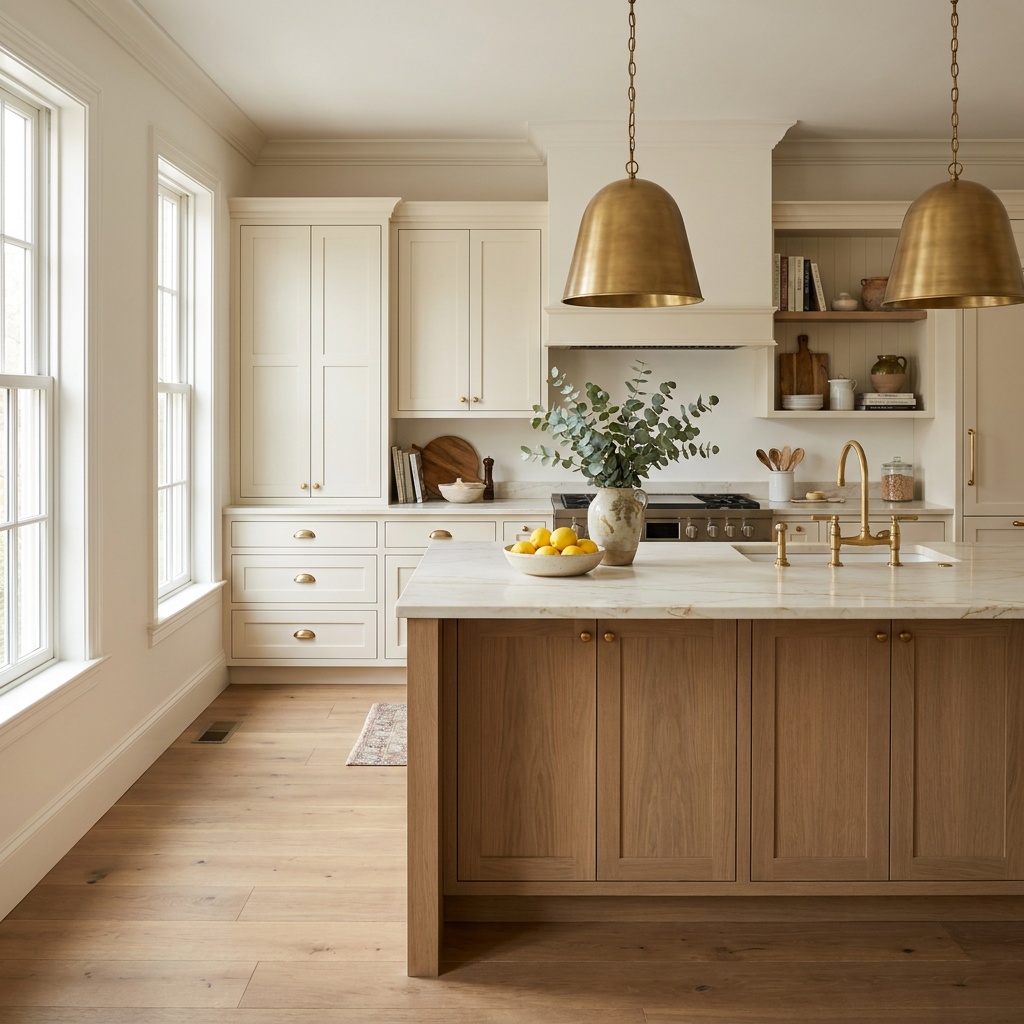
Ivory Kitchen Cabinets: The Short Answer
Ivory is a warm off-white, generally landing at a light reflectance value in the low 80s over a soft yellow or greige base, against the 90-plus LRV and cooler base of a stark white. In the 2026 design-trend surveys, warm neutrals led every other color family at 96 percent, while cool gray sat at 43 percent and stark white at 47 percent. Ivory keeps a kitchen bright under North Atlanta’s heavy tree canopy without the hard glare pure white can take on at midday, and it sits comfortably beside white oak, unlacquered brass, and the cream-and-taupe veining that runs through most quartzite. The one real risk is undertone. The wrong ivory under the wrong bulbs reads yellow, and no amount of styling fixes it later. Choosing it well means testing the color in your own room, at three times of day, against your actual counter and floor samples.
Why Warm Neutrals Took Over From Gray
Cool gray cabinetry ran the kitchen market for roughly a decade, and it did that job well: it read as new and made a builder-grade kitchen feel deliberate. What changed is the room around it. Flooring moved from gray-washed oak to warmer rift-sawn white oak. Lighting moved from 4000K daylight bulbs to 2700K. Countertops moved from solid whites toward stones with beige, gold, and mushroom movement in them. Against all of that, a cool gray door reads flat.
The replacement is not one color but a family: creamy off-whites, ivory, greige, mushroom, and soft taupe. The same 2026 surveys put earthy greens second at 86 percent and warm browns like walnut and caramel at 67 percent, and both pair with ivory more easily than with gray. Ivory is the neutral that lets a two-tone kitchen work without a fight, and it hides the fine dust and door-edge shadowing that a flat white exaggerates.
Ivory, Cream, Greige, and Stark White Are Not the Same Color
These words get used interchangeably in showrooms, which is how homeowners end up with a door sample they did not expect. The separation is measurable: LRV tells you how much light a color bounces back, and undertone tells you which way it leans when light hits it.
| Finish family | Typical LRV | Undertone | Reads as | Watch for |
|---|---|---|---|---|
| Stark white (Chantilly Lace type) | 90+ | Neutral to blue | Crisp, gallery-like | Shows every shadow line and fingerprint; can feel cold in north light |
| Warm ivory (White Dove, Alabaster type) | 82–83 | Soft yellow-gray | Bright but settled | Needs a cool counter or wall to stay balanced in strong afternoon sun |
| Cream (Swiss Coffee type) | ~82 | Clearer yellow | Traditional, softer | Leans buttery under 2700K bulbs; test before committing |
| Greige / mushroom | 55–70 | Gray-beige | Grounded, quieter | Darkens a small kitchen quickly; usually better on a base run or island |
| Stained white oak | Varies | Golden to neutral | Natural, textural | Grain and stain vary between batches; approve the actual door |
The two-point LRV gap between White Dove and Swiss Coffee sounds trivial and is not. On a full run of perimeter cabinets under downlights, that difference is the line between an off-white that stays neutral and one that clearly reads cream. If you want a single takeaway: ivory is white with the temperature turned up, not beige with the color turned down.
How Ivory Behaves in North Atlanta Light
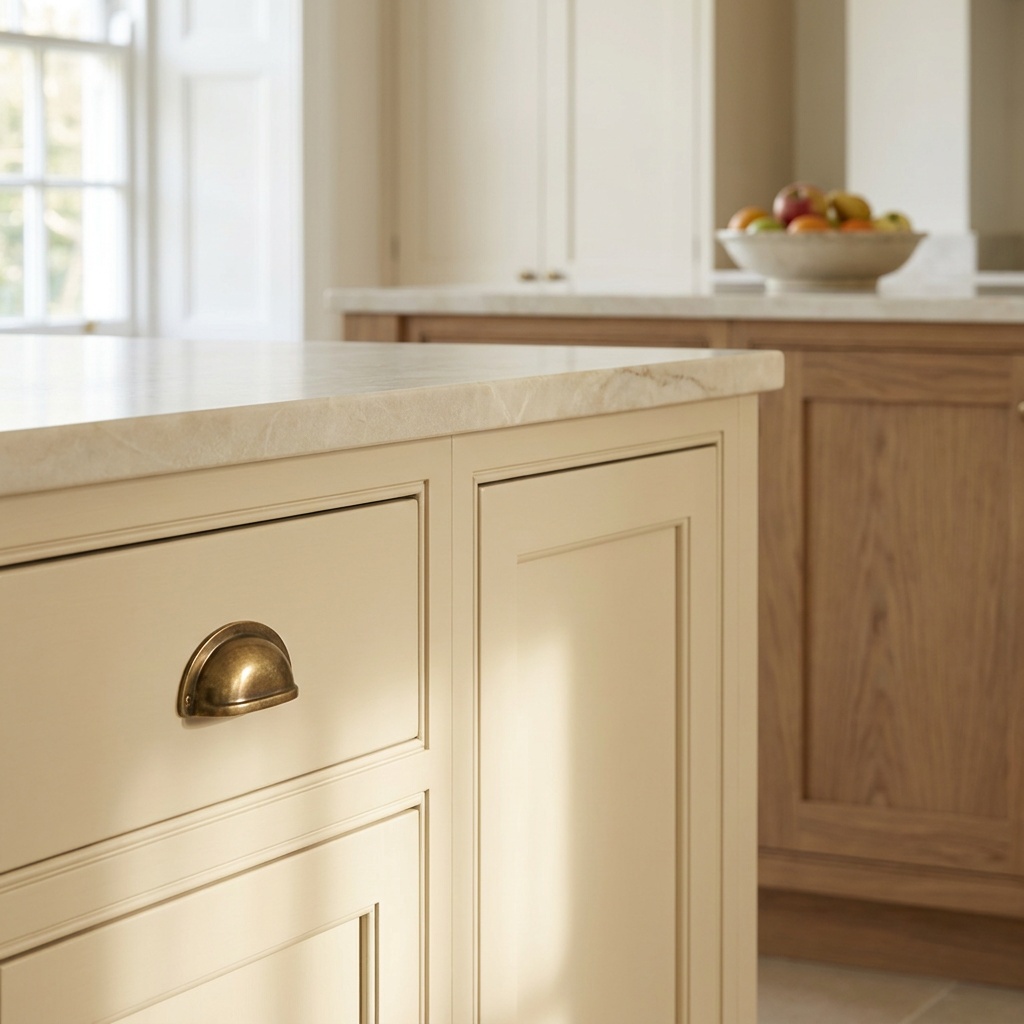
Light here is not the light the paint chip was photographed in. Much of Alpharetta, Milton, and Roswell sits under mature hardwoods, and that canopy filters daylight green before it reaches your window. A neutral white can pick up that cast and look slightly dingy in a shaded kitchen. Ivory, because it already carries warmth, absorbs the green shift instead of showing it.
Orientation matters just as much. North- and east-facing kitchens get cooler, bluer light and generally do better with a warmer ivory. South- and west-facing kitchens take a strong yellow wash in the afternoon, especially from late spring through September, so a cooler ivory holds its neutrality better there.
Three habits solve nearly all of it. Get a real door sample in the finish you intend to buy, not a paint chip, because sheen changes how a color reads. Look at it in the actual room at 9 a.m., at 2 p.m., and after dark with your lights on. Then specify 2700K to 3000K bulbs at a color rendering index of 90 or better, and keep that temperature consistent across recessed cans, undercabinet strips, and pendants. Mixed color temperatures are the most common reason a well-chosen ivory looks wrong once the kitchen is finished.
What Ivory Pairs With
Countertops
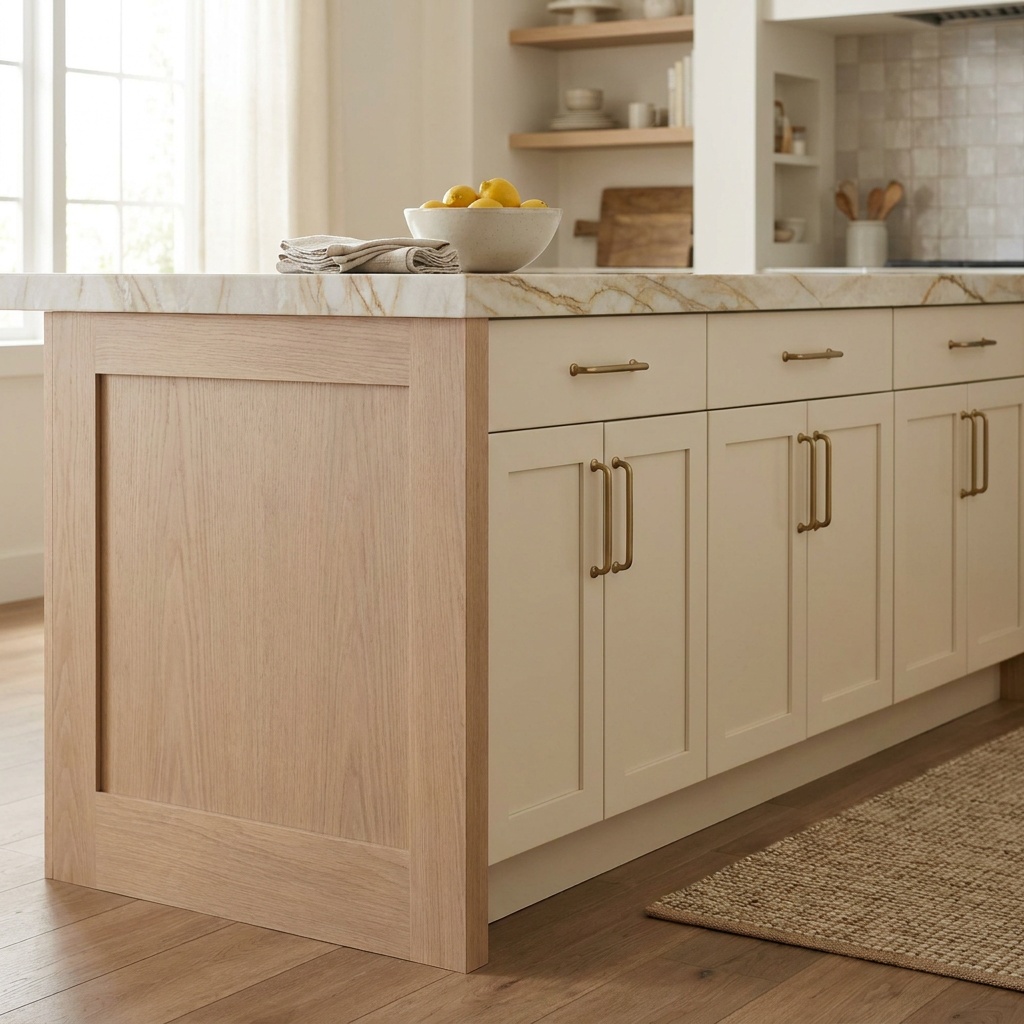
Ivory’s natural partner is a stone with warm movement rather than a solid cool white. Quartzite in the Taj Mahal family, with its cream field and soft gold veining, is the pairing you see most often here, and it holds up to the kind of cooking that etches marble. Warmer granites and warm-toned engineered quartz work equally well. Approach a bright optic-white quartz carefully, because at close range it can make ivory doors look yellow rather than warm. If you are still deciding between materials, our quartz, quartzite, and granite comparison covers the maintenance and heat differences, and the Taj Mahal quartzite guide goes deeper on the specific stone.
Backsplash
Ivory gives a handmade backsplash room to be interesting. Glazed zellige tile in an off-white or pale green, with its uneven surface and pooling glaze, catches light in a way a machine-made subway tile cannot, and the color variation between tiles reads as intentional next to a warm cabinet. A full-height slab of the counter material is the quieter option, and the easier one to clean behind a range.
Hardware and fixtures
Unlacquered brass is the finish most often specified with ivory, and it is a living finish: it darkens where hands touch it and stays bright where they do not. That patina is the point, but understand it before you buy, because it cannot be undone short of polishing. Satin brass and champagne bronze give the same warmth without the change, and polished nickel works if you want a cooler counterpoint.
Wood and two-tone layouts
The most durable version of this look pairs ivory perimeter cabinets with a stained white oak or walnut island. It keeps the room bright at eye level and puts the warmer tone where it anchors the space. Mid-tone oak flooring in a matte finish keeps the whole palette in one temperature family.
The Finish Matters as Much as the Color
An ivory kitchen lives or dies on the finish, not the color name. Cabinetry sprayed in a shop with a catalyzed conversion varnish is harder and more chemical-resistant than anything brushed on site, and on a warm off-white that shows up as doors still looking clean around the trash pullout after five years. Ask what the finish system is and whether doors are sprayed flat in a shop.
Sheen is the other decision. Satin is the usual choice on ivory: enough sheen to wipe down, not enough to spotlight every ripple in a shaker rail. Matte looks superb on the day of the walkthrough and is unforgiving in a family kitchen.
One caution specific to warm whites: older solvent-based lacquers ambered with age, which is why some 1990s cream kitchens read yellower now than the day they went in. Modern waterborne and catalyzed finishes are far more stable, so ask what is being sprayed.
Will Ivory Date the Way Gray Did?
Every color dates eventually. The useful question is how gracefully. Gray depended on the rest of the room staying cool, so when floors and lighting warmed up, gray cabinets became the one element fighting everything else. Ivory sits closer to the middle and pairs with wood, brass, nickel, green, and blue without a rebuild.
The pragmatic move is to put the trend-sensitive money where it is cheap to change. Cabinet color, counter, and layout are the decade-long decisions. Hardware, light fixtures, stools, and wall color are the ones you can swap in a weekend.
What Drives the Price of an Ivory Kitchen
Color itself rarely moves the number much. What moves it is everything attached to the color: door style, since inset doors take more labor than a full-overlay shaker; the finish system, since a shop-sprayed conversion varnish costs more than standard factory paint; whether you replace boxes or refinish sound ones; and how much of the kitchen moves, because relocating plumbing and adding circuits brings permits and inspections. Two ivory kitchens of the same size can land far apart on all four counts. Our Alpharetta kitchen remodel cost guide breaks down where the money actually goes, and any range you read there still depends on your layout, your material choices, and what we find once the old cabinets come out.
Frequently Asked Questions
Do ivory cabinets look yellow?
A well-chosen ivory reads warm, not yellow. The colors that go yellow are usually creams with a strong yellow base placed in a south- or west-facing kitchen and lit with 2700K bulbs, which stacks warmth on warmth. Two fixes prevent it. Pick an ivory with a slight gray in the undertone rather than a pure yellow one, and balance it with a cooler counter, wall color, or backsplash. Test a real door sample in your own kitchen in morning light, afternoon light, and under your fixtures at night before you order.
What is the difference between ivory, cream, and off-white cabinets?
They describe the same neighborhood at different depths. Off-white is the broad category for any white softened away from pure. Ivory sits in the low 80s for light reflectance with a gray-yellow undertone, so it stays bright while losing the coolness of a true white. Cream carries a clearer yellow base and reads noticeably softer and more traditional in the same room. No manufacturer applies these terms consistently, which is why the sample door and its light reflectance value matter more than the name printed on the label.
What countertop looks best with ivory cabinets?
Stones with warm movement work best: quartzite in the cream-and-gold family, warm-toned engineered quartz, or a granite with beige and gold in the field. The pairing to approach carefully is a bright optic-white quartz set directly against ivory doors, because the contrast at close range can make the cabinets look yellow. Bring your door sample to the slab yard rather than the other way around, look at both in daylight near the bay door, and view the full slab before it is fabricated.
Can I paint my existing cabinets ivory instead of replacing them?
Sometimes, and the deciding factor is the boxes rather than the doors. If the cabinet boxes are solid, square, and laid out the way you want to live, refinishing or refacing is reasonable and the doors can be sprayed in a shop for a far better finish than any on-site brushwork. If the layout is wrong, the boxes are particleboard that has swollen at the sink, or you want drawers where there are doors, paint spends money on a kitchen that still will not work. Decide the layout question first.
Are ivory cabinets harder to keep clean than white?
They are generally easier. Ivory hides fine dust and the faint traffic shadow around handles better than a stark white, which shows both. What matters more than color is the finish system and the sheen: a shop-sprayed catalyzed finish in satin wipes clean with a damp microfiber cloth and resists the cooking oils that build up beside a range. Avoid abrasive powders and bleach-based sprays on any painted cabinet, and clean spills near the cooktop before they cure rather than scrubbing them later.
Thinking about ivory for your own kitchen? Book a design consultation and we will bring real door samples into your kitchen, and look at them in your own light before anything is ordered. We work throughout North Atlanta, including Milton and Roswell, and you can reach us at 404-640-2361.