Taj Mahal Quartzite vs. Granite: The Short Answer
Taj Mahal quartzite runs $90 to $150 per square foot installed, while granite in the Atlanta market runs $50 to $100 per square foot installed in 2026. For a typical 30-to-40-square-foot kitchen, that puts a Taj Mahal countertop project at roughly $5,000 to $9,000, versus $2,000 to $4,000 for most granite installations. What the premium buys is specific: a soft ivory surface with wispy gold veining that reads like marble, a Mohs hardness of 7 to 7.5 (slightly harder than most granite), and a surface that shrugged off lemon juice, vinegar, and ketchup for 15 hours in fabricator testing without a single etch mark. Granite answers back with a lower price, hundreds of color options, and less frequent resealing. If your saved photos all show pale, veined stone, Taj Mahal is the honest match. If you want maximum durability per dollar, granite still earns its reputation.
What Taj Mahal Quartzite Actually Is
Taj Mahal is a natural quartzite quarried in Brazil. Quartzite begins as quartz-rich sandstone that heat and pressure compress into an extremely dense stone — a different origin story from granite, which forms when magma cools slowly underground and develops its characteristic crystal flecks.
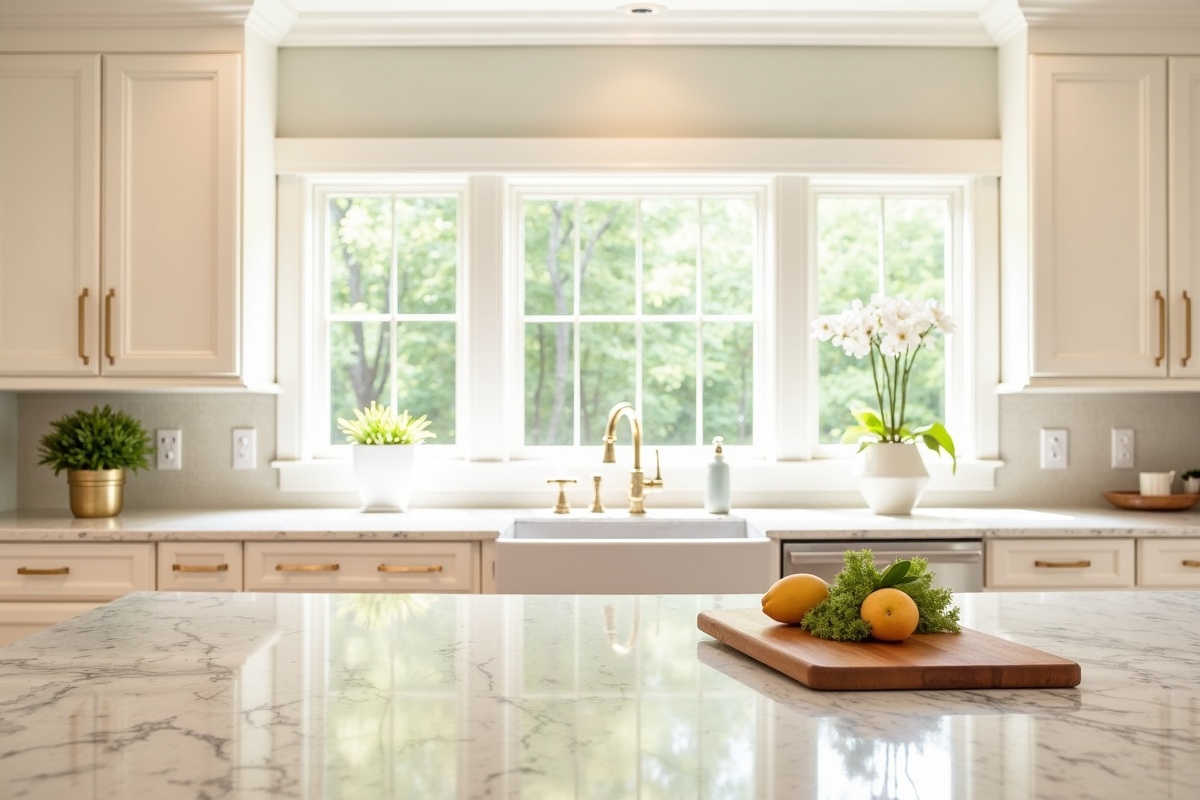
That geology explains the look. Taj Mahal has a soft white-to-ivory background with subtle gold and taupe veins that move across the slab the way marble veining does. It is the stone behind a large share of the light, warm kitchens filling design boards right now — and it pairs naturally with warm ivory cabinetry and aged brass hardware, a combination we see requested constantly across North Atlanta.
One point of frequent confusion: quartzite is not quartz. Quartz countertops are an engineered product — ground stone bound with resin. Quartzite is 100 percent natural stone, cut from a quarried block, which is why no two Taj Mahal slabs are identical and why fabricators encourage you to pick your actual slab in person.
Taj Mahal Quartzite vs. Granite: Comparison Table
| Factor | Taj Mahal Quartzite | Granite |
|---|---|---|
| Installed cost (Atlanta, 2026) | $90–$150 per sq. ft. | $50–$100 per sq. ft. |
| Typical 30–40 sq. ft. kitchen | $5,000–$9,000+ | $2,000–$4,000 |
| Hardness (Mohs scale) | 7–7.5 | 6–7 |
| Heat tolerance | Excellent; avoid sudden temperature shocks | Excellent; among the most heat-tolerant surfaces |
| Etching from acids | None in 15-hour fabricator tests | Highly resistant |
| Staining | Resists oil and coffee when sealed | Slightly more stain-resistant out of the box |
| Resealing | Every 12–18 months | Less frequent than quartzite |
| Look | Ivory background, marble-like veining; slab-to-slab variation | Widest color range of any natural stone, from near-white to deep black |
| Best fit | The marble look without marble’s fragility | Maximum durability per dollar; color flexibility |
What Each Stone Costs in North Atlanta in 2026
Countertop pricing has three layers: the slab, the fabrication, and the installation. For Taj Mahal, slabs run $60 to $100 per square foot — premium lots reach $135 — and fabrication plus installation adds another $30 to $50 per square foot, which is how the installed total lands between $90 and $150, according to a 2026 fabricator pricing guide. Quartzite’s hardness is part of that cost: cutting it requires diamond tooling and more shop time than softer stones.
Granite is friendlier to the budget. Atlanta-area pricing for 2026 puts granite at $50 to $100 per square foot installed, with professional installation itself running $30 to $60 per square foot, per an Atlanta stone supplier’s 2026 cost breakdown.
Two line items move the number on either stone. Upgraded edge profiles — ogee, waterfall — add $10 to $25 per linear foot. And finish matters: a honed or leathered texture typically adds $10 to $25 per square foot over standard polished. Build both into your comparison before you compare bids, and read our 2026 kitchen remodel cost guide for Alpharetta to see where countertops sit inside a full project budget — typically a modest slice next to cabinetry.
Durability: Where the Two Stones Separate
Both stones are hard enough for real kitchens. Granite sits at 6 to 7 on the Mohs hardness scale; Taj Mahal measures 7 to 7.5, which puts it at or above the steel of most kitchen utensils. Neither will scratch from normal cooking, and stone suppliers such as MSI rate natural quartzite as more durable than granite overall.
The more interesting test is acid. Marble etches — lemon juice or vinegar leaves permanent dull spots — and because Taj Mahal looks so much like marble, buyers assume it shares the weakness. It does not. In documented fabricator testing, lemon juice, vinegar, ketchup, ammonia cleaner, and a multi-purpose cleaner sat on a Taj Mahal sample for 20 minutes, one hour, and 15 hours overnight. The result: no etching, no rough patches, no dull spots. The same testing left olive oil and coffee on the sealed surface overnight with no visible staining. This is the practical difference between quartzite and the marble it resembles — you can squeeze a lemon over dinner prep without a second thought.
On heat, both stones take hot cookware in stride. Granite is often described as one of the most heat-tolerant counter materials available, and quartzite performs comparably. The one caution that applies to both — and to every natural stone — is thermal shock: a pan straight off a high flame onto a cold slab, repeatedly, in the same spot. A trivet is cheap insurance for either material.
Maintenance: The Honest Difference
This is the category granite wins. Both stones are porous and rely on a penetrating sealer to resist stains, but granite generally holds its seal longer, while quartzite is best resealed every 12 to 18 months. Resealing is a 20-minute wipe-on, wipe-off task, not a service call — but it is a recurring task, and you should know that going in.
The test for either stone is simple: drip a little water on the surface near the sink. If it beads, the seal is working. If it darkens the stone within a few minutes, it is time to reseal. Day to day, both stones want the same care — mild dish soap and water or a stone-specific cleaner, and skip vinegar-, citrus-, bleach-, or ammonia-based products, which degrade the sealer over time even when they cannot touch the stone itself.
Which Stone for Which Kitchen
Choose Taj Mahal quartzite if the look is the point. If every photo you have saved shows pale stone with soft veining, granite in a different palette will read as a compromise every morning. Taj Mahal delivers that exact look with better acid resistance than the marble it resembles, and its ivory-and-gold tones flatter the warm cabinet colors dominating 2026 kitchens. In the larger kitchens we see in Milton and Johns Creek, it is the most requested stone for waterfall islands, where the veining can run uninterrupted down the sides.
Choose granite if value and variety lead. Granite offers the widest color selection of any natural stone — near-whites, warm speckled neutrals, dramatic near-blacks — at roughly half to two-thirds the installed cost of Taj Mahal. It holds its seal longer and gives up almost nothing in everyday durability. For a hard-working family kitchen, a rental-ready renovation, or a budget where the savings would fund better cabinetry, granite remains one of the smartest allocations in the room.
A middle path worth knowing: some homeowners put Taj Mahal on the island — the surface everyone sees and gathers around — and a complementary granite or quartz on the perimeter runs. It concentrates the budget where the eye lands. You can see how we balance stone selections against the rest of the project in our kitchen and bath remodeling work across North Atlanta.
Frequently Asked Questions
Is Taj Mahal quartzite more expensive than granite?
Yes. Taj Mahal quartzite runs $90 to $150 per square foot installed in 2026, while Atlanta-area granite runs $50 to $100 per square foot installed. For a typical 30-to-40-square-foot kitchen, that is roughly $5,000 to $9,000 for Taj Mahal versus $2,000 to $4,000 for granite. The gap comes from slab cost — Taj Mahal slabs run $60 to $135 per square foot before fabrication — and from the diamond tooling its hardness demands. Exotic granites can close the gap, but standard granite is consistently the lower bid.
Does Taj Mahal quartzite etch or stain like marble?
No. In documented fabricator testing, lemon juice, vinegar, ketchup, and ammonia-based cleaner sat on a Taj Mahal sample for up to 15 hours with no etching, no rough patches, and no dull spots — exposure that would permanently mark marble. Staining is also minimal when the stone is sealed: olive oil and coffee left overnight produced no visible stains in the same tests. Keep the seal current, and Taj Mahal gives you marble’s appearance without marble’s fragility around acids.
Can you put hot pans directly on quartzite or granite?
Both stones tolerate brief contact with hot cookware far better than engineered quartz, whose resins can scorch. Granite is regarded as one of the most heat-tolerant countertop materials available, and quartzite performs comparably. The caution for both is thermal shock: repeatedly setting a pan straight off a high flame onto the same spot of cool stone can, in rare cases, stress the slab. A trivet or folded towel is inexpensive insurance, and it also protects the sealer, which is less heat-tolerant than the stone itself.
How often do quartzite and granite countertops need sealing?
Plan on resealing Taj Mahal quartzite every 12 to 18 months; granite typically holds its seal longer, often stretching well past that interval. The check is the same for both: drip water on the surface, and if it darkens the stone within a few minutes instead of beading, it is time to reseal. The job itself is simple — wipe on a penetrating stone sealer, let it absorb, buff it off — and takes about 20 minutes for a full kitchen.
Is Taj Mahal quartzite the same thing as quartz?
No, and the similar names cause real confusion at bid time. Taj Mahal quartzite is a natural stone quarried in Brazil — sandstone transformed by heat and pressure into one of the hardest countertop materials available. Quartz countertops are engineered: ground mineral bound with polymer resin, made in a factory in consistent patterns. Quartzite handles heat better and carries one-of-a-kind veining; quartz never needs sealing and offers uniform slabs. Make sure any bid you compare says which one it is pricing.
Deciding between quartzite and granite for your own kitchen? Book a design consultation or call 404-640-2361 — we will bring slab options that fit your palette and your budget to one table, so the decision gets made on paper, not on demo day.