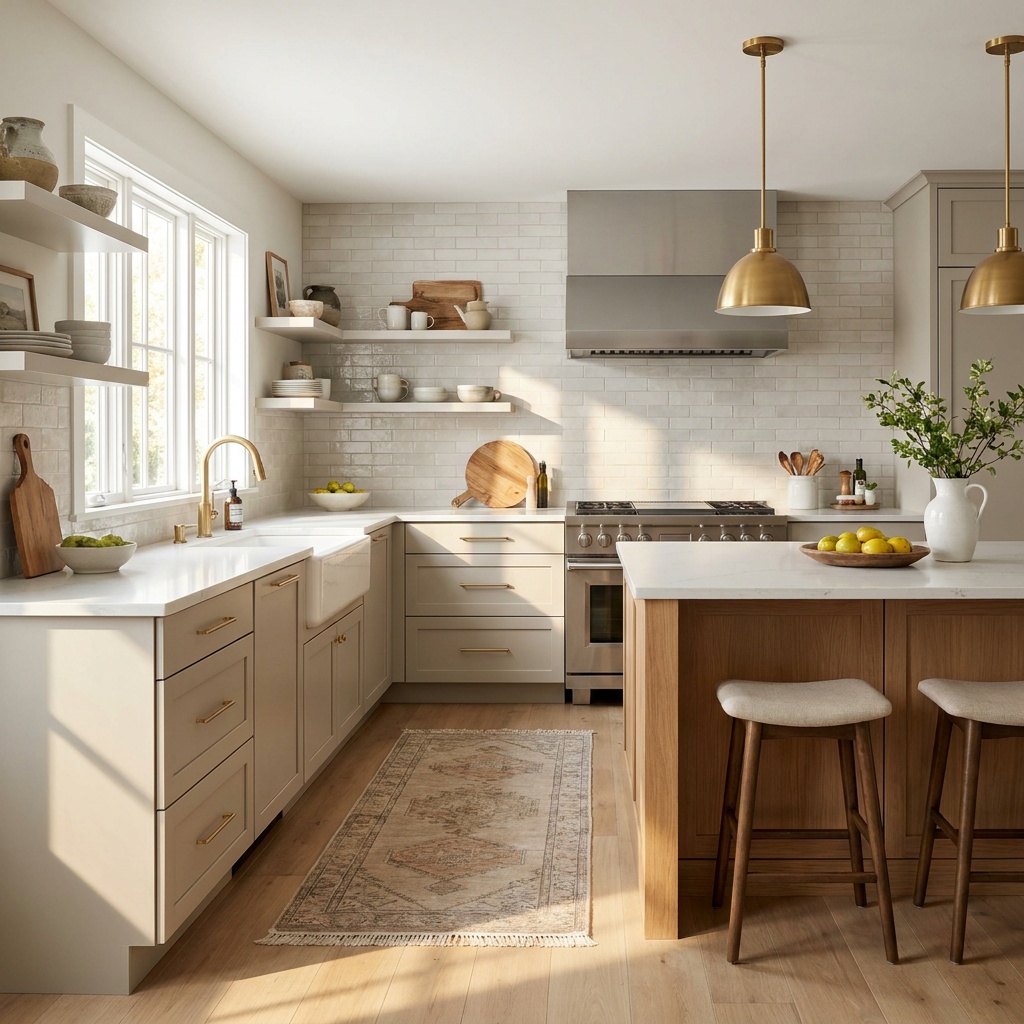
A standard base cabinet is 24 inches deep, and that one number settles most of the argument. Behind a door with a fixed shelf, only the front 10 to 12 inches get used day to day; the back half becomes storage you kneel down and reach into, which in most kitchens means it quietly stops being storage at all. A drawer on full-extension slides brings all 24 inches out into the room, so the pot at the back is as easy to reach as the one at the front. That is why the working rule in most new layouts is drawers for nearly every base cabinet and doors only where they earn the spot: under the sink, under a cooktop, in a blind corner, and wherever a full-height door is hiding a pull-out system. Hardware is rarely the limit. Standard full-extension slides are commonly rated around 75 to 100 pounds per pair, and heavy-duty versions run from 150 pounds upward, which covers a stack of cast iron with room left over.
The 24-inch problem
Every base cabinet in a normal kitchen is the same box: roughly 24 inches deep, 34.5 inches tall before the countertop goes on, and as wide as the layout allows. The depth is set by the countertop, not by how anyone stores things, and it is deeper than a human arm is comfortable working in at floor level.
Two things happen inside that box when you close it with a door. First, contents stack front to back and your eye only sees the front row: a 24-inch shelf holds two or three rows of mixing bowls, and everything behind the first row has to be moved before it can be counted. Second, a two-door base in a face-frame kitchen usually has a center stile down the middle of the opening, so the widest object that can pass is roughly half the cabinet width. That is why a 36-inch base can refuse a sheet pan.
What a drawer base does with that depth
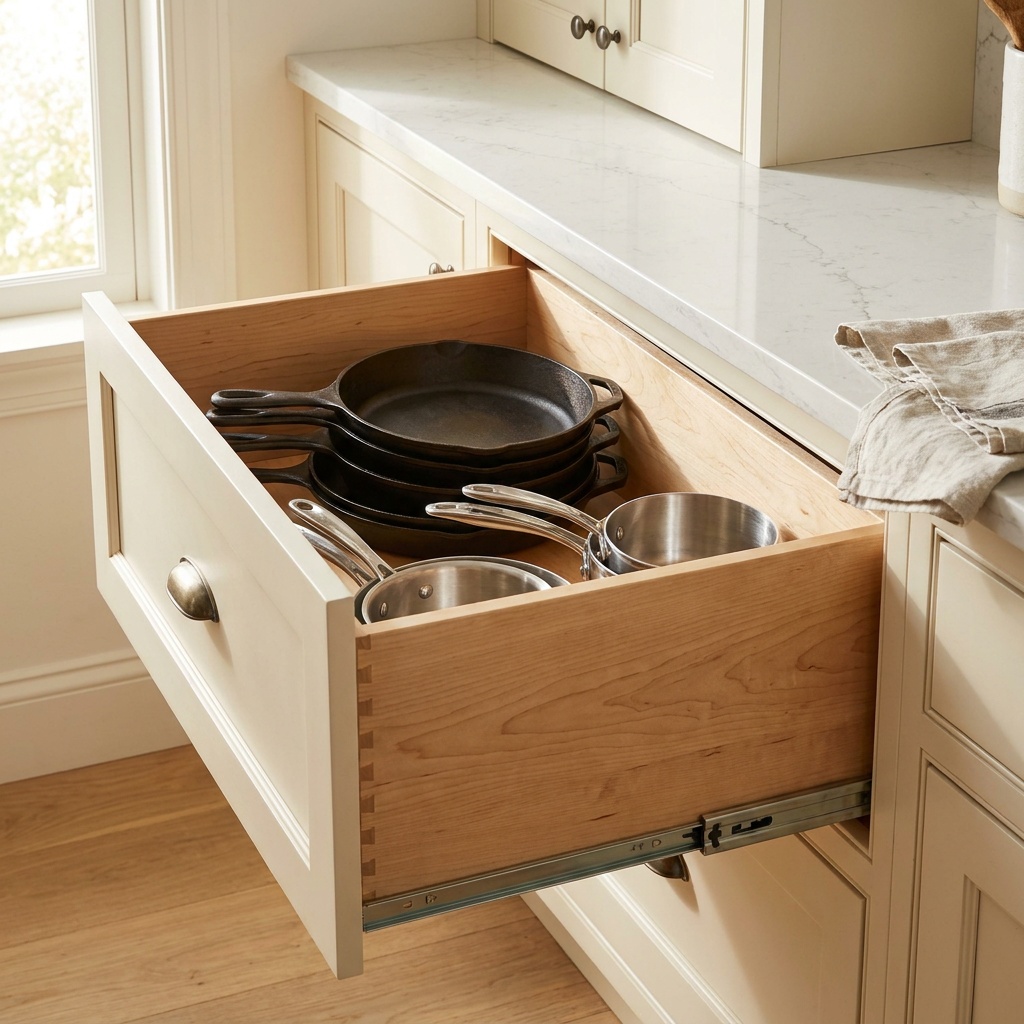
A drawer on full-extension slides travels its entire length out past the cabinet face. Nothing stays hidden, nothing gets stacked behind anything, and the whole contents read at a glance from above. That is the practical difference, and it is bigger than it sounds: the back half of every base cabinet in the kitchen goes from occasional to everyday.
The other gain is the missing center stile. A drawer box spans the full opening, so a 30-inch drawer takes a roasting pan sideways and a bank of drawers beside the range will swallow every pot in the house. Weight is rarely the constraint. Ratings are published per pair at full extension, because capacity drops the further a drawer travels, and a pair of good slides rated at 100 pounds carries more dishware than anyone loads into one drawer.
Construction matters more than the marketing does. A box built from half-inch or five-eighths-inch solid maple or birch, dovetailed at the corners with a captured plywood bottom, stays square under load; a stapled particleboard box with a nailed-on bottom sags, and a sagging bottom is what makes an old drawer bind. Soft-close earns its place on deep drawers for the same reason — 60 pounds of cookware slams hard, and the damper is what keeps the joints tight.
What a door-and-shelf base does with it
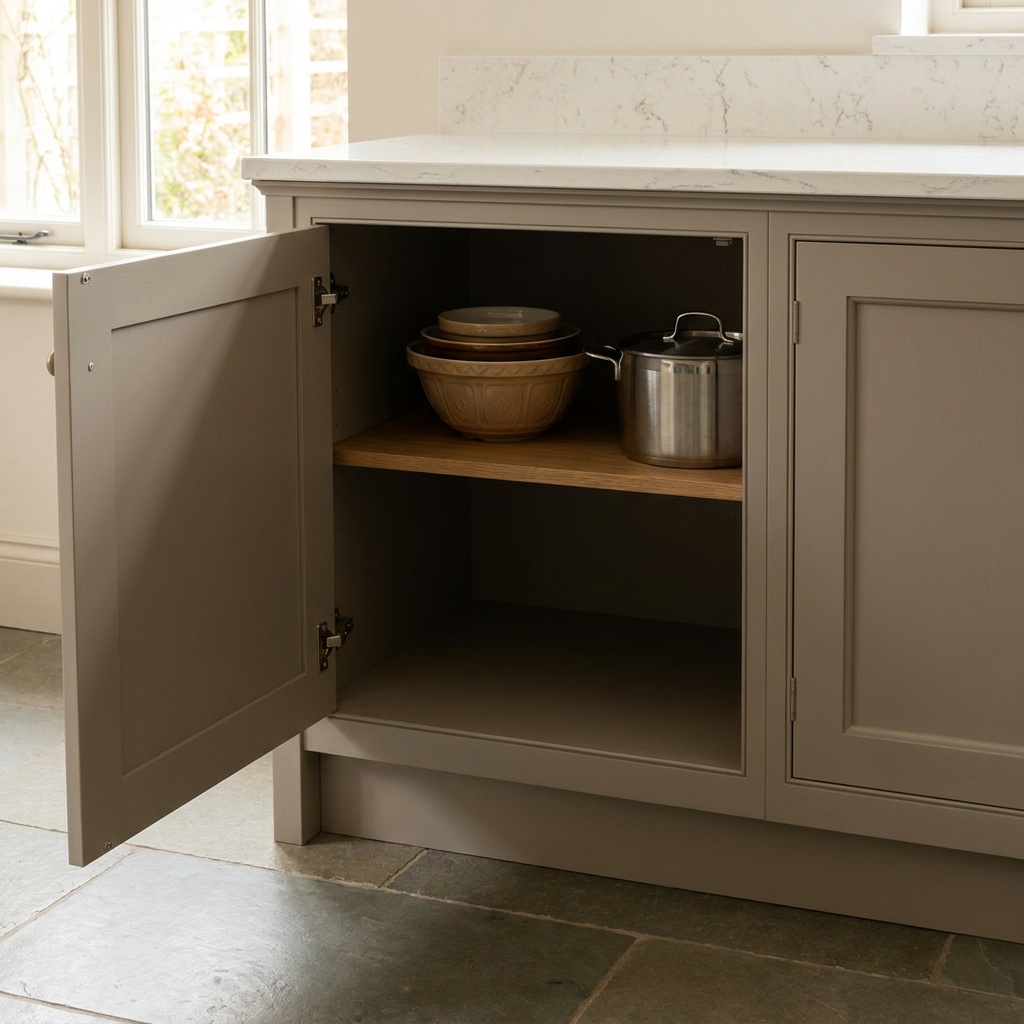
Doors are not a mistake, and a kitchen where every base is a drawer bank can look restless. What a door does well is give you one tall, unbroken opening. Anything that needs height — a stand mixer, small appliances you do not want on the counter, a tall trash and recycling pull-out, platters standing on edge — lives more easily behind a door, because a drawer divides the box horizontally and you cannot borrow height from the drawer above.
The problem is never the door. It is the fixed shelf behind it, which turns a 24-inch box into two shallow shelves with dead space behind each. When a door base is the right answer, treat the interior as pull-out anyway: roll-out trays on full-extension slides give the reach of a drawer with the tall clear opening of a door.
Drawers and doors side by side
| Drawer base | Door base with fixed shelf | Door base with roll-outs | |
|---|---|---|---|
| Depth you actually use | Full 24 inches | Front 10 to 12 inches | Full 24 inches |
| How you see contents | From above, all at once | Front row only | From above, one tray at a time |
| Clear opening | Full width, no center stile | Split by a stile on two-door boxes | Tray runs narrower than the opening |
| Tall items | Limited to that drawer’s height | Full height of the box | Full height above the top tray |
| Best for | Pots, pans, dishes, utensils, food storage | Small appliances, trash pull-outs, sink plumbing | Retrofits, pantry bases, corner access |
| Main limit | Cannot turn a corner or clear plumbing | Back half goes unused | Doors still have to be opened first |
Where doors still win
Four places, reliably. The sink base has a trap, supply lines, and often a disposal in the way, so the most a drawer can do there is a shallow U-shaped box that straddles the plumbing, or a tip-out tray behind a false front. Bowl configuration changes how much room is left underneath, which is worth weighing when you pick the sink.
A cooktop base is similar: the burner box drops in and takes the top several inches, so the top drawer is a false front and only the lower drawers are real. A slide-in range needs its own opening entirely.
Blind corners cannot be drawers — a drawer pulls straight out and the corner runs away at 90 degrees, so corners get a door with a swing-out mechanism or a rotating shelf. And the seating side of an island is knee space, not storage, which is why islands end up with a drawer bank on the working side and panels on the other.
Sizing a drawer bank that actually works
The common arrangement is three drawers: a shallow top drawer around 6 inches of interior height for utensils and gadgets, and two deeper drawers below. Deep drawers land around 10 to 12 inches inside, which is what it takes to stand saucepans upright or lay a stock pot on its side. The way to size them is to measure the tallest object you want in each one and add roughly two inches of clearance so nothing catches on the drawer above.
Two variations are worth knowing. A two-drawer base gives one very deep drawer for large cookware, at the cost of the utensil drawer. And an inner drawer — a shallower drawer nested inside a deep one, behind the same front — recovers the headroom wasted above short items without adding another line to the cabinet face.
Dividers are what keep any of this working after the first month. Pegs in a dish drawer stop a stack from walking, and a knife tray makes the shallow drawer readable. The narrow drawer beside the range is usually the best home for spices on an angled insert, well away from the heat of a cabinet above the range.
Face frame or frameless changes the math
A frameless cabinet is a plain box, so the drawer opening is nearly the full outside width minus the panel thickness and the slides. A face-frame cabinet has a wood frame applied to the front, and the stiles typically overlap the opening by more than an inch on each side, so the drawer box has to be narrower to clear it. The result is that the same 24-inch cabinet gives noticeably more drawer interior in frameless construction.
Slide type follows from that. Side-mount slides hang on the cabinet sides and work in either construction. Undermount slides ride below the box, disappear from view, and usually carry the soft-close mechanism, but they need a specific box height, a notch in the back, and on face-frame cabinets a bracket to bridge the frame. None of this shows from the outside. It decides how much fits and how the drawer feels fifteen years in, which is why construction deserves more of the conversation than it usually gets.
What it does to the way the room reads
Swapping doors for drawers is not a neutral change visually. A run of door bases reads as tall vertical panels; a run of three-drawer banks reads as stacked horizontal bands, and the room feels lower and calmer. The hardware count roughly triples, so pull choice starts carrying real weight — long bar pulls emphasize the horizontal, while small knobs on wide drawer fronts read as undersized.
Alignment becomes visible too. Drawer fronts line up across the whole run, so any inconsistency in reveal or drawer height shows as a broken line at eye level. The fronts also have to agree with the doors: a shaker drawer front with the same rail width keeps the run coherent, while a slab front beside profiled doors reads as two kitchens. In older kitchens around Milton and Roswell, that mismatch is often the tell that bases were replaced piecemeal rather than planned as a run — and if the boxes are sound, it is sometimes solvable with new fronts and a properly prepped finish.
Drawer bases are the pricier way to build a base cabinet — more hardware, more boxes, more labor per linear foot — and what drives that is the number of drawers, the slide grade, and the cabinet construction, not the finish. Our kitchen remodel cost guide for Alpharetta covers which decisions move a budget, the Milton kitchen remodeling page shows how these choices play out in local layouts, and the Alpharetta Kitchen & Bath home page lists the full range of services.
Frequently Asked Questions
Should every base cabinet be drawers?
Close to it, but not literally every one. The sink base has to work around the trap and the disposal, a cooktop base has to clear the burner box, and a blind corner needs a door because a drawer cannot turn a corner. Everywhere else — beside the range, in the island, in the prep zone — drawers reach the full depth of the box and doors do not. A practical rule is drawers by default, doors only where plumbing, an appliance, or a corner forces the issue.
Do drawers hold less than a cabinet with a shelf?
They hold slightly less raw volume and considerably more of what you can use. A drawer box gives up about an inch on each side to the slides plus the thickness of its own walls, so the interior is narrower than the cabinet opening. What it gains is the back half of the cabinet. In a door base with one fixed shelf, the rear 12 inches of a 24-inch-deep box is space you kneel to reach, so most people stop loading it. Drawers bring that depth out to you at standing height.
Can I add drawers to the cabinets I already have?
You can add roll-out shelves behind the existing doors, which is a different thing and often the right one. The doors stay, and pull-out trays on full-extension slides sit inside the box. Measure the narrowest point of the opening and subtract about an inch for the slides; on face-frame cabinets the frame overlaps the opening, so trays run on rear brackets or side cleats and come out narrower still. Converting to true drawer fronts means new fronts, new boxes, and usually a new cabinet.
What height should a pot drawer be?
Measure the tallest thing you want standing upright in it, then add about two inches of clearance so nothing catches on the drawer above. In practice that puts most deep drawers around 10 to 12 inches of interior height, which takes a stock pot lying down or a stack of saucepans standing. A three-drawer base usually runs a shallow top drawer near 6 inches for utensils with two deeper drawers below.
If you are laying out a new kitchen and trying to decide which bases get drawers, bring your cookware measurements to the conversation — the tallest pot and the widest pan settle most of it. Book a consultation or call 404-640-2361, and we will plan the run around what you actually cook with.