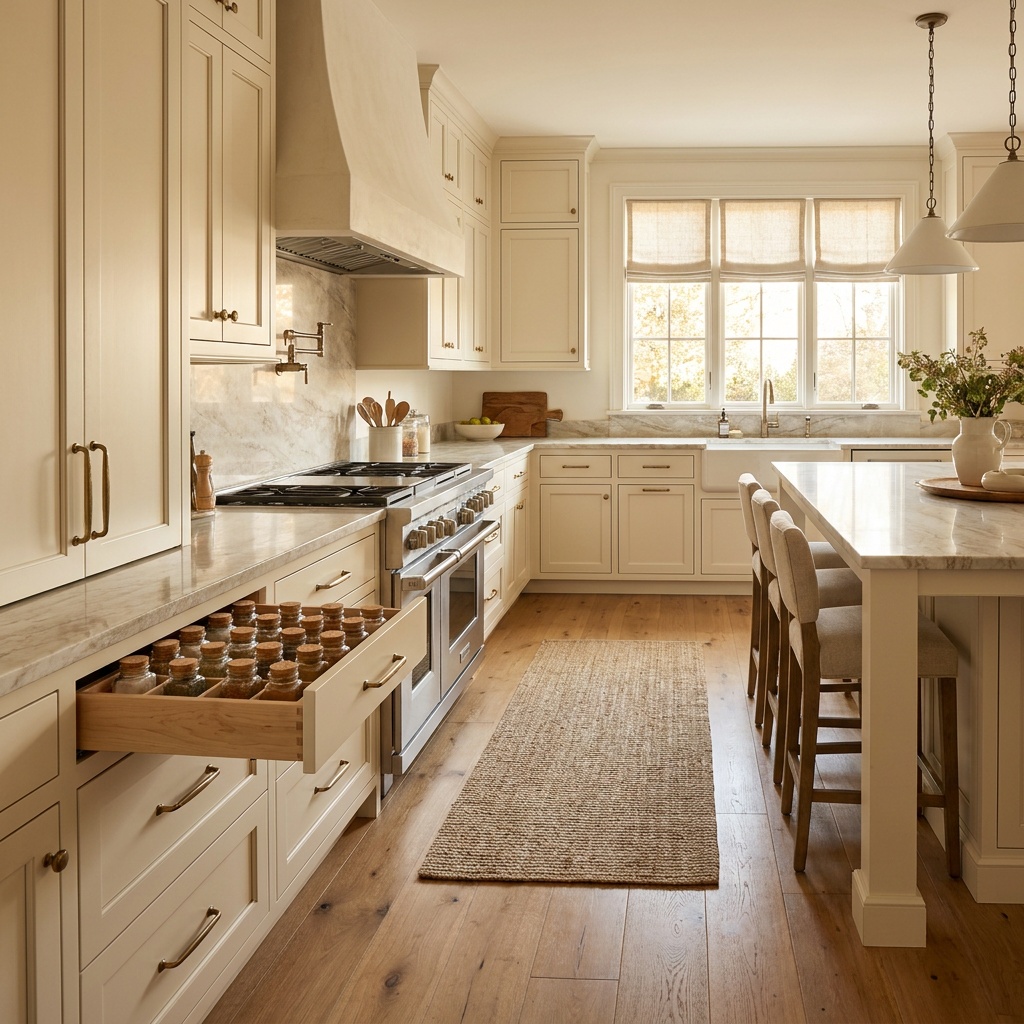
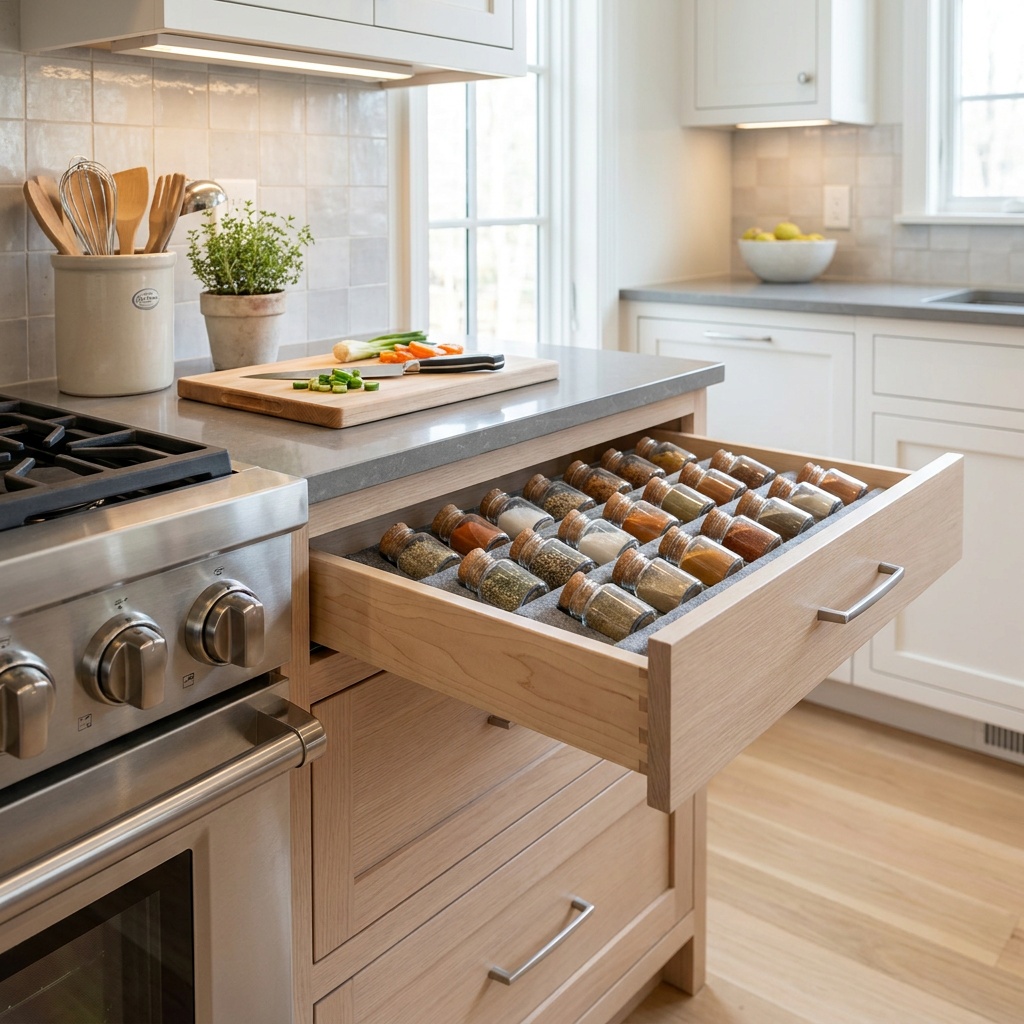
Most kitchens keep spices in one of four places, and the right one depends on how many jars you own and where you actually cook. A shallow drawer with an angled insert next to the range is the most usable option for anyone past a dozen jars: tiers pitched roughly 30 to 45 degrees turn every label upward, so a drawer with about 3 to 4 inches of interior clearance and 21 inches of width reads at a glance and holds around 30 standard jars. A door-mounted rack keeps six to twelve everyday jars in your line of sight, but costs the shelf behind it 3 to 4 inches of depth. A narrow pull-out tower converts a 6- or 9-inch gap of filler into vertical storage where no jar ever hides behind another. And the default arrangement in most kitchens, spices loose on a 12-inch upper shelf, is the one that fails, because that shelf holds three rows deep and only the front row is ever visible.
Why the ordinary spice cabinet quietly fails
A standard upper cabinet is 12 inches deep, a base cabinet 24, and a spice jar roughly 2 inches across. So an upper shelf swallows five or six rows of jars and a base shelf eleven, while your eye and your hand only ever reach the first one. Everything behind the front row becomes archaeology, which is how three half-used jars of cumin end up in one kitchen.
Height compounds it. The comfortable reach zone runs from roughly 24 to 60 inches off the floor, and the first shelf of a standard upper cabinet sits at about 54 inches with the second at 66. The moment spices go on the second shelf up, reading a label means a step stool or a guess.
Then there is location. Ground spices hold real flavor for something like six to twelve months, whole spices for three or four years, and heat, light, and humidity all shorten that. The cabinet directly above the range is the worst spot in the kitchen for them, which is one reason a well-planned kitchen gives that space to the hood and its ducting instead. The cabinet beside the dishwasher, which vents warm damp air at the end of every cycle, is the runner-up.
The four options at a glance
| Angled drawer insert | Door-mounted rack | Narrow pull-out tower | Shelf with tiered riser | |
|---|---|---|---|---|
| Typical capacity | 15 to 40 jars | 6 to 12 jars | 20 to 30 jars | 9 to 15 jars |
| Where it goes | Shallow drawer near the range | Inside an upper or base door | A 3 to 9 inch filler gap | An existing upper shelf |
| How you read labels | Tops, from above | Fronts, at eye level | Tops and fronts, from the side | Fronts, front row only |
| What it costs you | A drawer you had other plans for | 3 to 4 inches of shelf depth | Filler that was doing nothing | Nothing, and it shows |
| Jar shape tolerance | Low, needs consistent jars | Low, fixed rail spacing | Medium | High |
| Best for | Serious cooks, large collections | A short everyday set | Tight layouts with no drawer to spare | Renters and stopgaps |
Angled drawer inserts: the one most people should choose
A spice drawer works because it defeats depth. Laying jars down on tiers pitched 30 to 45 degrees puts every lid facing up and every label in one plane, so a 21-inch drawer with three or four rows shows you thirty jars in a single glance with nothing stacked behind anything.
The constraint is interior clearance: roughly 3 to 4 inches clear inside the box, enough for a jar on its side plus the pitch of the tier, and not so deep that the drawer starts collecting taller things. That usually means the top drawer in a bank, which is also the one nearest your hands while you cook. If you were saving that drawer for utensils, make the trade consciously, because utensils tolerate a jumble and spices do not.
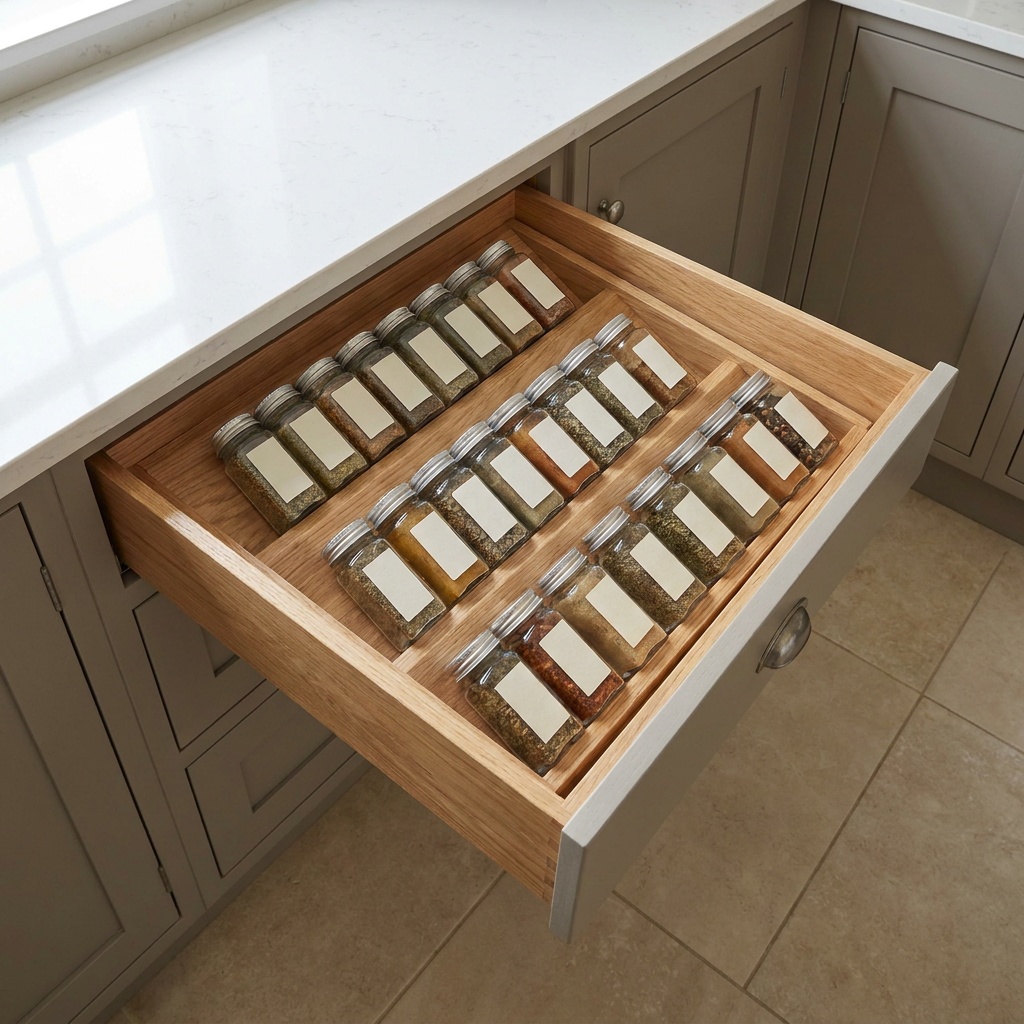
Inserts come as fitted wood trays cut for a specific drawer width, as expandable plastic tiers, and as cabinetry accessories ordered with the boxes. Fitted wood looks correct in a nice kitchen and does not slide around; expandable versions are the sensible choice for drawers you already own. Either way, measure the interior of the box rather than the face.
Door-mounted racks: excellent for a short list, frustrating for a long one
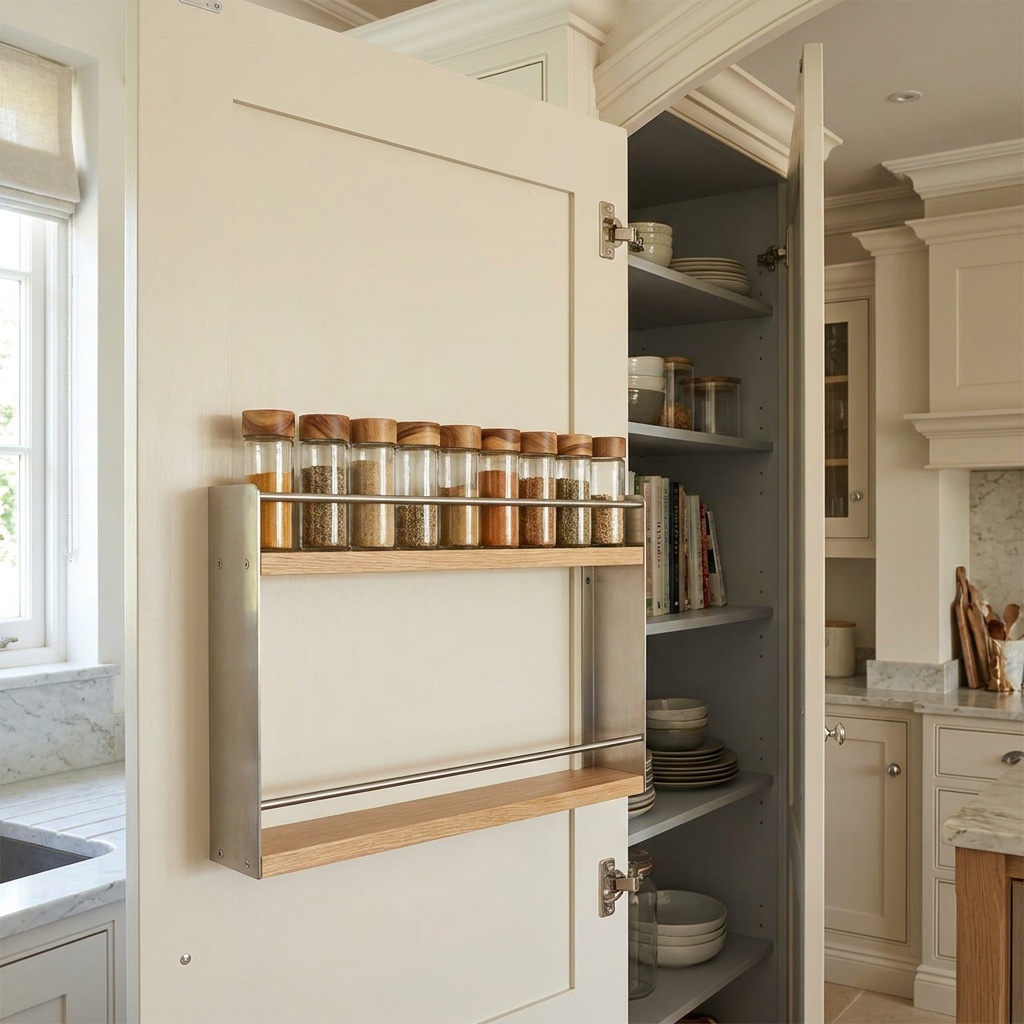
A rack on the back of a door puts a small set of jars at eye level, one row deep, in a sight line you already use. For the eight or ten things you reach for constantly, salt, pepper, paprika, chili flakes, cinnamon, oregano, it is the fastest storage in the kitchen.
The cost is depth. A loaded rack projects 3 to 4 inches into the box, and the shelves behind it have to be notched, shortened, or set back so the door can close. In a new cabinet order that is a specified detail; on an existing cabinet it is a Saturday of refitting shelves, and the first sign you got it wrong is a door that thumps against a jar. Fixed rail spacing is the other limit: a rack sized for short jars decides what shape of jar you buy from then on.
Narrow pull-out towers: the fix for kitchens with nothing to spare
Every kitchen has dead width: the gap between a run and a wall, the filler beside a range, the few awkward inches left when the cabinet math did not come out even. A pull-out tower turns 3, 6, or 9 inches of that into a rack that comes fully out into the room, so you read jars from the side with nothing behind anything.
Two things separate a good one from a wobbly one. The first is the slide: full-extension, soft-close, rated for the loaded weight, because a tall narrow pull-out full of glass is heavier than it looks and a cheap slide will bind within a year. The second is the rail or lip retaining the jars, since everything on a tall pull-out gets accelerated and stopped on every use. A tower without one redistributes your spices across the floor on the first hard close.
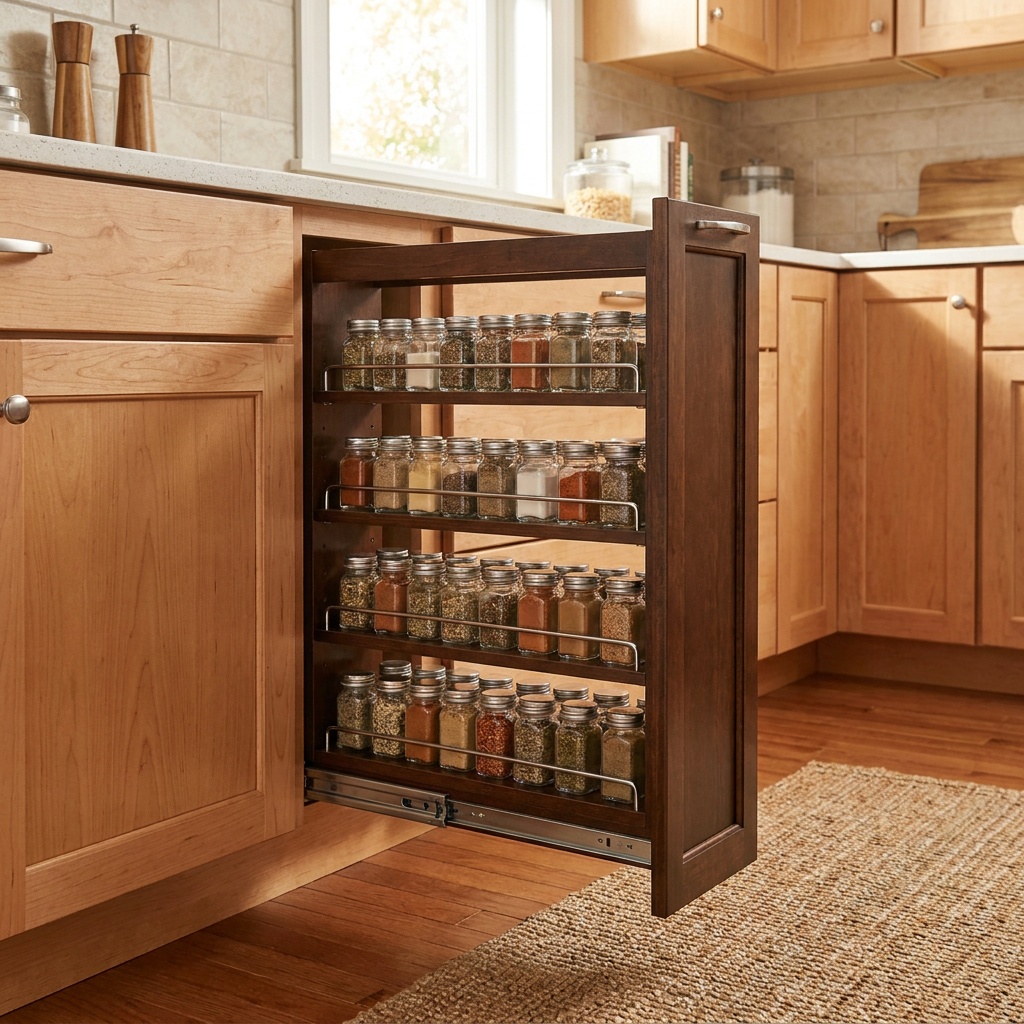
It is also the retrofit that most often makes sense in an older Alpharetta or Milton kitchen where the cabinets are sound but the layout wasted a few inches at the end of a run. Swapping a decorative filler for a pull-out does not touch the rest of the room.
Risers, magnetic strips, and the ones that disappoint
A tiered riser on an existing shelf is the easiest improvement available, and it does help: three stepped levels let you read three rows instead of one. What it cannot do is fix the rows behind it. As a stopgap in a kitchen you are not remodeling, a riser is fine. As the plan for one you are, it is a missed opportunity.
Magnetic tins on a wall or a refrigerator door photograph beautifully and perform poorly. They are small, so you refill them constantly; they sit in room light, which is what degrades the contents; and unless they are labeled on the face, you are identifying paprika by sight. Open shelves of matched glass jars have the same problem in a prettier form.
Where spices belong in the plan
Spice storage is a zoning decision before it is a hardware decision. The jars should land within a step of the cooktop and the prep counter, between counter height and about 60 inches, and away from the heat and steam of the range and the dishwasher. In practice: the drawer bank beside the range, the base cabinet on the prep side of the island, or a pull-out in the filler between them.
It is the same logic that governs a coffee bar or beverage station, clustering what gets used together out of the main traffic path. And if you are planning glass-front cabinets, keep the spices out of them: a wall of mismatched supermarket labels is not the display you want lit.
Size it to the jars you actually own
Before choosing anything, put every spice you own on the counter and count. Most households land between 15 and 25 jars; anyone cooking across several cuisines runs 40 or more, often in three jar shapes at once. That number decides the answer more than any design preference does. Under 12 jars, a door rack is enough. Between 15 and 40, a drawer insert wins. Past 40, plan a drawer plus a narrow pull-out for backstock.
Decanting into one matched jar shape makes every one of these systems work better, since inserts and racks are built around consistent dimensions. It only sticks if you write the name and the date on the jar. And measure your tall oddities, the vanilla, the pepper grinder, the bay leaves, then give them their own spot rather than letting three bottles dictate the system for the other thirty.
Build it in, or add it later
Ordered with new cabinetry, a spice drawer is a specified insert in a box built for it and a pull-out is a cabinet rather than a filler, so both arrive fitted and aligned. Added later, both are still straightforward.
Retrofitting gets harder when the boxes have to change, notching shelves for a door rack or converting a door-and-shelf base to drawers. Decide that while you are deciding on refinishing or repainting the cabinets, since the boxes are open and the doors are off anyway. Storage details get settled during planning alongside layout and materials, the stage covered in our Alpharetta kitchen remodel planning guide, and they are the easiest thing in the room to get right and the most annoying to live without.
Frequently asked questions
What is the best spice storage for a small kitchen?
A narrow pull-out in a filler gap, because it uses width that was doing nothing rather than taking a drawer or a shelf you need for something else. A 6-inch pull-out holds roughly 20 to 30 jars in space that would otherwise be a decorative panel. If there is no filler to convert, a door-mounted rack on the cabinet nearest the range is the next best option, provided the shelves behind it can be set back far enough for the door to close.
How deep should a spice drawer be?
About 3 to 4 inches of clearance inside the drawer box. That is enough for a standard jar lying on its side on an angled tier with the lid facing up, and shallow enough that the drawer stays dedicated to spices instead of collecting utensils. Measure the interior of the box, not the drawer face, since the face is typically an inch or more taller than the space inside.
Should you store spices above the stove?
No. Heat and steam are two of the three things that strip flavor from ground spices, and the cabinet above a range collects both every time you cook. The same applies to the cabinet beside a dishwasher, which vents warm damp air at the end of each cycle. Keep spices within a step of the range but not directly over it, in a drawer or pull-out that stays cool and dark between uses.
Are door-mounted spice racks worth it?
They are worth it for a short, stable set of everyday jars, and frustrating for a large collection. A rack puts eight or ten jars at eye level one row deep, which is the fastest access in the kitchen. In exchange it takes 3 to 4 inches of depth from every shelf behind it and locks you into jars that fit its fixed rail spacing. If your collection is growing or your jars are mismatched, a drawer insert handles it better.
Planning a kitchen where the storage works
Spice storage is a small decision made either deliberately in the drawing or accidentally on move-in day. We work through storage zones, cabinet interiors, and layout together at the start of every kitchen project across Alpharetta and North Atlanta. Take a look at what we do, then book a consultation or call 404-640-2361.