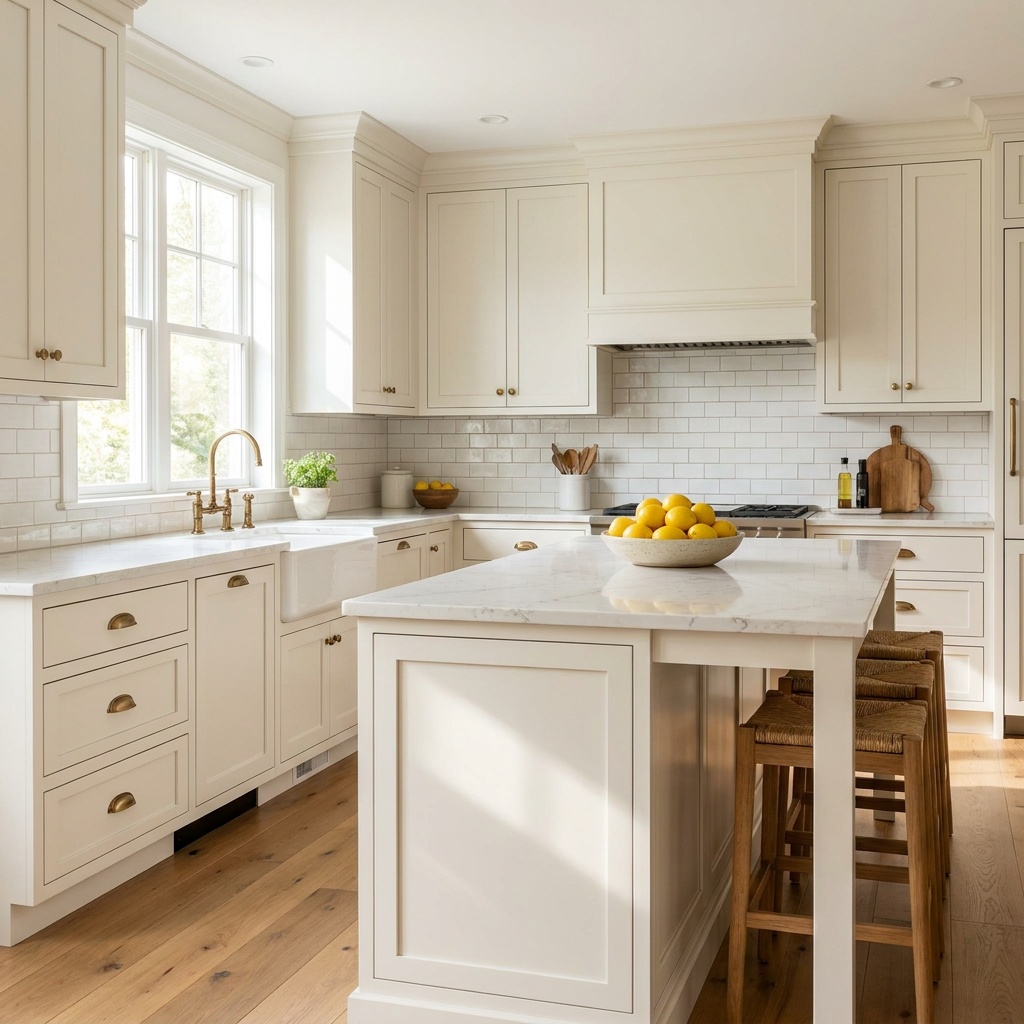
A cabinet repaint holds up or fails on three things: how the surface was prepped, what coating went on it, and whether the finish was allowed to cure. Get all three right and a sprayed cabinet-grade enamel commonly looks good for 10 to 15 years, with plenty of kitchens going past 20. Wall paint brushed onto degreased-but-unsanded doors often starts chipping at the drawer edges inside 12 to 24 months. The gap is not the color or the brand on the can. A sprayed film lands at roughly 2 to 3 mils per coat and reaches full hardness in about two weeks; the same product brushed on at 4 to 6 mils takes three to four weeks and never cures as hard, because thickness slows the crosslinking that makes the film tough. Everything below hangs off those three decisions.
Where repainted cabinets actually fail
Failures are not random. They cluster in the same five places in kitchens all over North Atlanta:
- The sink base doors. Water runs down the face, sits on the bottom rail, and wicks into any edge the finish did not seal.
- The door beside the dishwasher. Steam from a cracked-open dishwasher hits the same six inches of stile every cycle, and softening starts here first.
- The trash pull-out. Opened with a knee, a hip, and dirty hands dozens of times a day.
- Drawer top edges. Skin oil plus fingernails on an uncured film equals a worn stripe within a year.
- The stile beside the range. Grease aerosol lands, gets wiped with degreaser, and the sheen dies in a vertical band.
Georgia summers add a variable. Waterborne enamels cure by evaporation and then crosslinking, and both slow down when the air is heavy, so a repaint sprayed in August reaches handling hardness later than the same job in October. Rushing doors back onto boxes causes more callbacks than any other single mistake.
Prep is most of the job
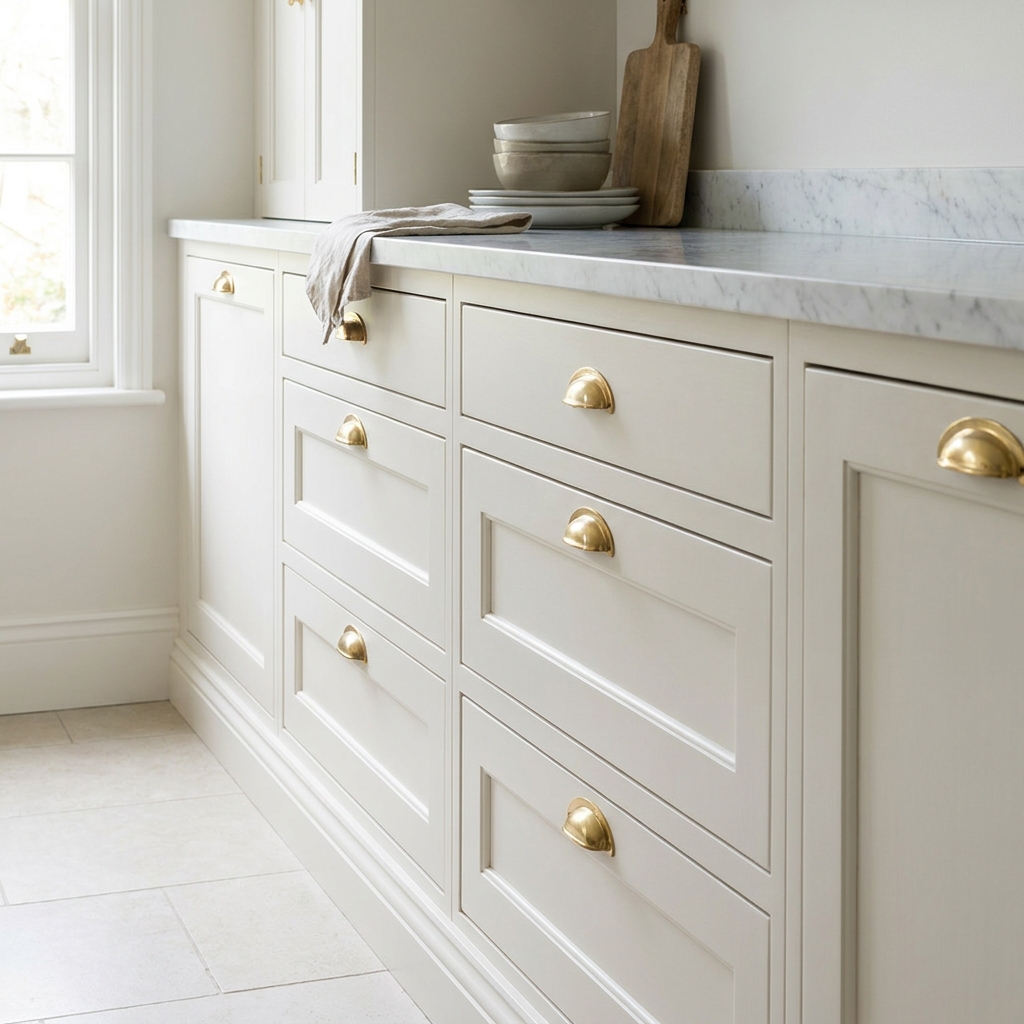
Degrease first, and mean it. Cabinets carry years of cooking aerosol, hand oil, and silicone from polishes and spray cleaners, and no primer bonds through that film. Doors and boxes get washed and dried before any abrasive touches them, because sanding a greasy surface drives the contamination into fresh scratches.
Then scuff. A 220-grit scuff over every face, edge, and profile gives the primer mechanical grip. This is not stripping — the goal is to kill the sheen uniformly. Any spot still flashing glossy under a raking light is a spot the primer will let go of.
Doors come off. Hinges and pulls get labeled and bagged, and the doors go flat on a rack. Painting them hung in place guarantees runs on the vertical faces and no finish on the edges that need it most.
Fix the substrate first. Loose joints get reglued and old hardware holes get plugged. Paint magnifies flaws rather than hiding them, and a filled hole that shrinks three weeks later is a permanent dimple.
Primer decides whether the color stays clean
A waterborne bonding primer is the default. It grips slick, previously finished surfaces that ordinary latex primer slides off of, and it sands and sprays cleanly. On maple, birch, poplar, or MDF doors it is all you need.
A shellac-based primer earns its place when the wood will fight you. Red oak, cherry, and knotty pine carry water-soluble tannins that migrate up through a waterborne film and surface as amber or pink blotches, worst around knots and end grain. It is a chemical reaction, not a coverage problem, and a third coat of white paint does not stop it. On oak going to a light color, shellac is the difference between a clean white and one that turns faintly tea-stained within a year.
Coatings that hold up, in order
| Coating | How it goes on | How it holds up | Where it belongs |
|---|---|---|---|
| Wall-grade acrylic latex | Brush, roller, or spray | Stays soft, blocks against itself, marks with a fingernail after a month | Walls and ceilings, not cabinetry |
| Waterborne alkyd or urethane-acrylic enamel | Sprayed on site | Cures hard and level, resists water and cleaners, touches up well | Repaints in an occupied home |
| Catalyzed conversion varnish or 2K urethane | Sprayed in a shop with dedicated ventilation | Hardest and most chemical-resistant; near-impossible to touch up invisibly | Doors finished off site, then installed |
| Factory-finished new doors | Not a coating decision at all | Longest life; a controlled line finish on a fresh substrate | Sound boxes, doors past saving |
The honest read: catalyzed finishes are the toughest coatings made for cabinetry, but they are a shop process, not something to spray inside a lived-in kitchen. A good waterborne enamel, sprayed in thin coats over a prepped and primed surface, is what a durable in-home repaint looks like — and a scuffed door can be repaired later without the patch reading as a different material.
Which doors take paint well, and which fight it
MDF and paint-grade hardwood are easy. MDF has no grain to telegraph and no tannins to bleed, so it takes a coating dead flat. Maple, birch, and poplar are nearly as cooperative, with tight closed grain that sands smooth and stays smooth.
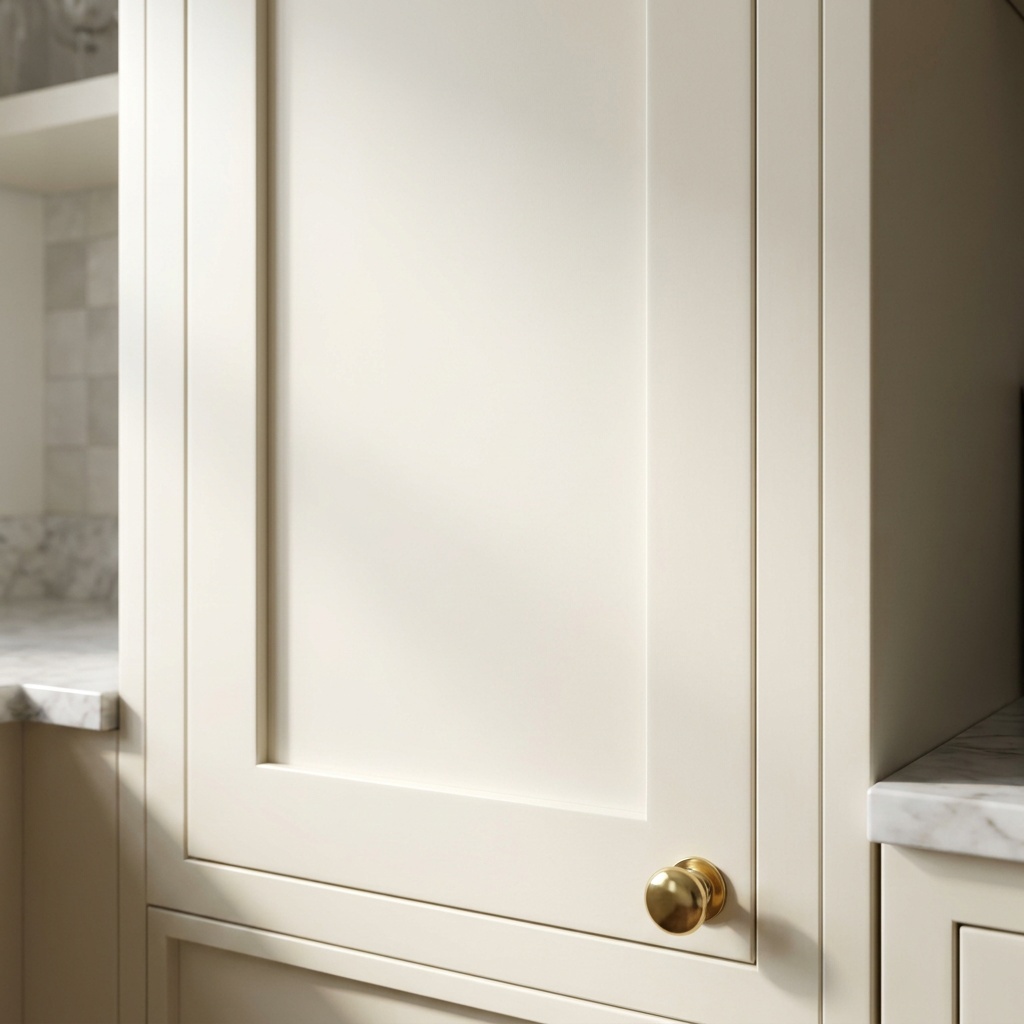
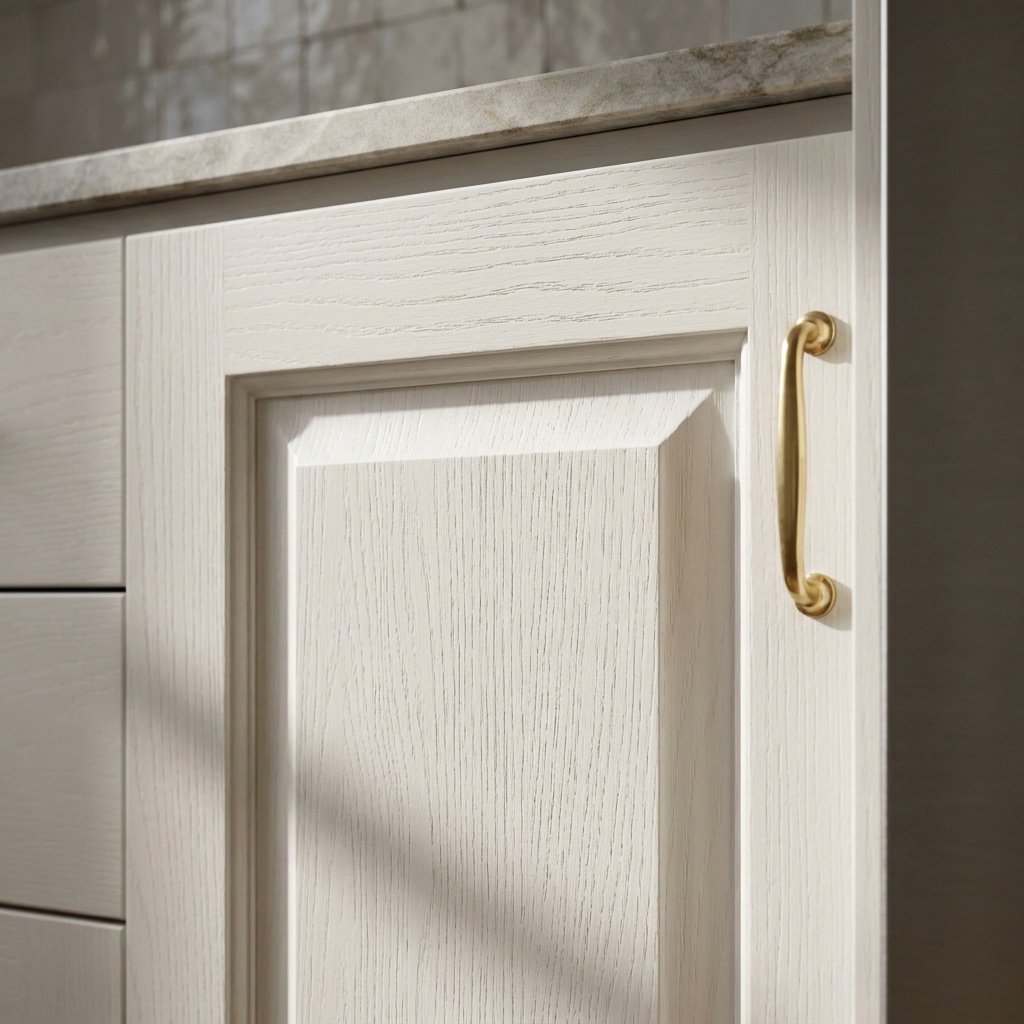
Red oak is the honest conversation. Oak’s open pores stay visible through paint. That is physics, not poor workmanship: a coating thin enough to be durable is nowhere near thick enough to bury a pore. Alpharetta, Roswell, and Cumming subdivisions built between about 1988 and 2004 are full of golden oak raised-panel doors, so this comes up constantly. Two answers work: fill the grain with a skim of filler and sand it back before priming, which adds a day or more of labor, or paint the oak as it is and accept a textured, linen-like surface that reads as character in a farmhouse kitchen and as a compromise in a modern one. Hoping four coats will fill it does not work.
Thermofoil and laminate doors need a different plan. These are a vinyl film heat-pressed over an MDF core, engineered to be nonporous and easy to wipe — exactly the properties that give a coating nothing to grab. Paint can be made to stick with an aggressive bonding primer, but the weak link stays underneath: the film itself. Where the vinyl has lifted at a corner or peeled near the range, paint locks the failure in rather than fixing it, and new doors on the existing boxes is the sounder route.
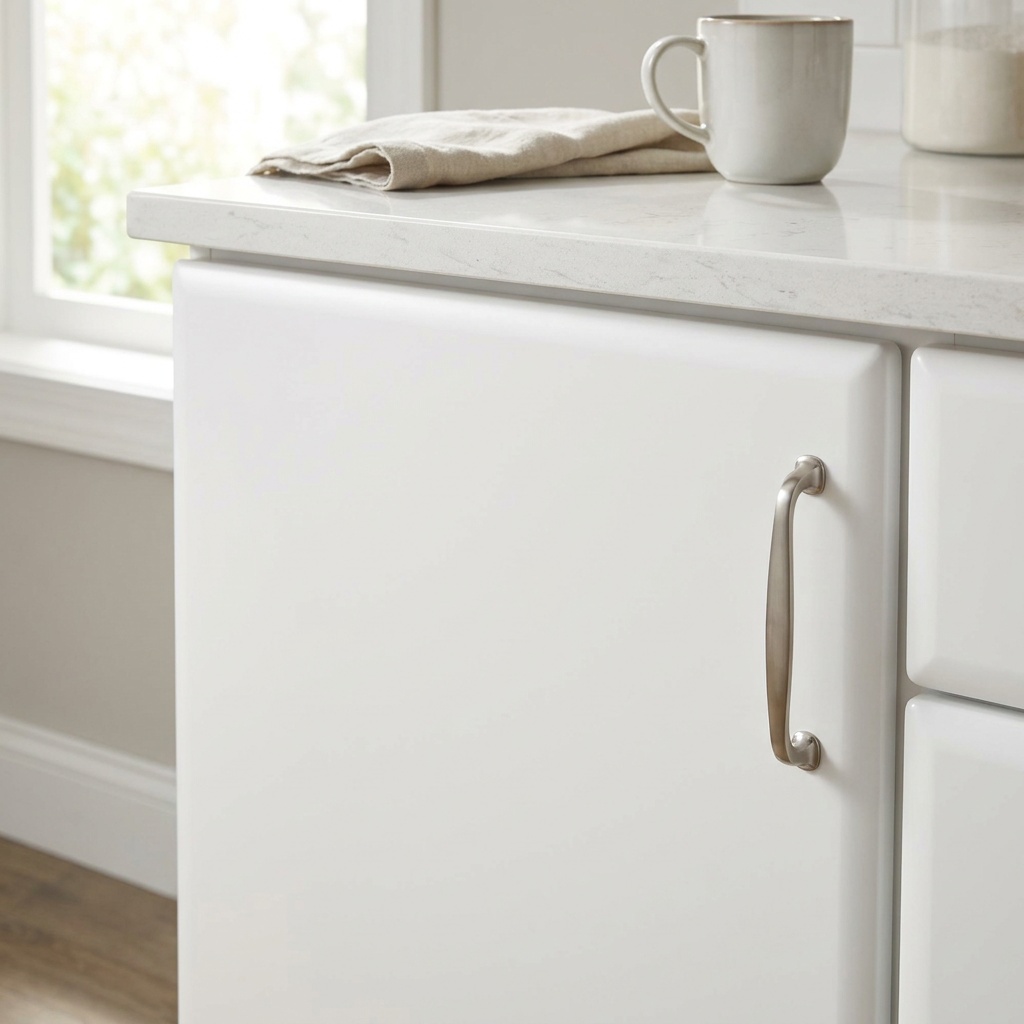
Profile matters too. A flat slab or a simple Shaker face sprays evenly in two passes; cathedral arches and deep raised panels have inside corners where atomized enamel pools, so they need lighter passes and more of them.
Sheen and color
Satin is where most kitchens land now. It has enough sheen to wipe clean and enough softness to forgive a substrate that is not laboratory-flat, which describes every 25-year-old door. Semi-gloss is marginally more washable, and it also shows fingerprints, roller stipple, and every dent you did not fill. On oak that was not grain-filled, satin is close to mandatory; higher gloss turns each open pore into a shadow.
On color, the warm-neutral shift of the last few years suits repaints particularly well, because warm whites and soft creams hide minor texture better than a cold, blue-leaning white. Our guide to warm ivory kitchen cabinets covers how those tones behave in north-facing Atlanta rooms. Whatever color you choose, look at a sprayed sample door in your own kitchen at three times of day, and check it against your countertops — if a new surface is on the table, the quartz, quartzite, and granite comparison is the place to start.
Spraying, and the cure nobody plans for
Spraying is what produces a factory-like surface, because atomized enamel lays down with no tool marks. A brush-and-roll job puts down a thicker, textured film that cures slower and softer even when the product is identical. Brushwork still earns its keep on box face frames, where masking an entire occupied kitchen is impractical — a common approach sprays every door and drawer front off site and hand-applies the frames, the surfaces hands touch least.
Then comes the part homeowners are rarely warned about. Doors can be handled in a couple of days, but the film keeps hardening for about 30 days, and during that window it is vulnerable to blocking — two coated faces pressed together will fuse and tear when separated. Doors should not close tight against the frame for several days after rehanging, ideally close to a week; small felt bumpers on the door backs hold a gap while the finish finishes. For the first month, clean with mild soap and water only, skip abrasive pads and degreasing sprays, and do not hang a wet towel over a door.
When a repaint is the wrong tool
A repaint changes color and finish. It does not change layout, box condition, or the 12 inches of dead space in a 1990s blind corner. Paint is the right call when the boxes are square and solid, the doors are wood or MDF and undamaged, and you want the room to look different rather than work differently. It is the wrong call when particleboard boxes are swelling at the sink base, when hinges have torn out of soft edges, or when the island is too small and the range is on the wrong wall — freshly painted cabinets in a layout that frustrates you are a good-looking version of the same daily annoyance. Our Alpharetta kitchen remodel guide lays out what a full project involves.
Frequently asked questions
How long do repainted kitchen cabinets last?
A sprayed cabinet-grade enamel over properly degreased, scuff-sanded, and primed doors typically looks good for 10 to 15 years, and many kitchens go past 20. Wall paint applied by brush and roller over minimal prep often starts chipping at drawer edges and around the sink within 12 to 24 months. What predicts lifespan is not the brand of paint but whether the surface was clean and abraded before the first coat, and whether the finish was left alone long enough to cure.
Can you paint thermofoil or laminate cabinet doors?
You can, with an aggressive bonding primer, but the paint is only as sound as the vinyl film underneath it. Thermofoil is a nonporous laminate heat-pressed onto an MDF core, designed to shed everything, which gives a coating very little to grip. Where the film has already lifted at a corner or bubbled near heat, painting seals the defect in rather than repairing it. On thermofoil kitchens with sound boxes, new doors on the existing frames is the more durable path.
Does oak grain show through painted cabinets?
Yes, unless the grain is deliberately filled first. Red oak has open pores that stay visible through any coating thin enough to be durable, so extra coats will not bury them. The two workable options are filling the grain with a skim of filler and sanding it flat before priming, which adds meaningful labor, or painting the oak as it is and treating the texture as part of the look. Textured painted oak suits farmhouse and transitional kitchens more than modern ones.
Do cabinets have to be sanded before painting?
They have to be degreased, and they should be scuffed. Degreasing comes first, because years of cooking aerosol and hand oil will defeat any primer, and sanding a greasy door only pushes contamination into fresh scratches. Once the surfaces are clean and dry, a 220-grit scuff over every face and edge dulls the old sheen and gives the primer mechanical grip. The goal is uniform dullness, not bare wood. Any patch still flashing glossy is a future chip.
Thinking about your own cabinets
The right answer depends on the door material, the condition of the boxes, and whether the layout still works for how you cook. That is a conversation in your kitchen, not a guess from a photo. Book a design consultation or call 404-640-2361, and we will tell you plainly whether your cabinets are worth painting.