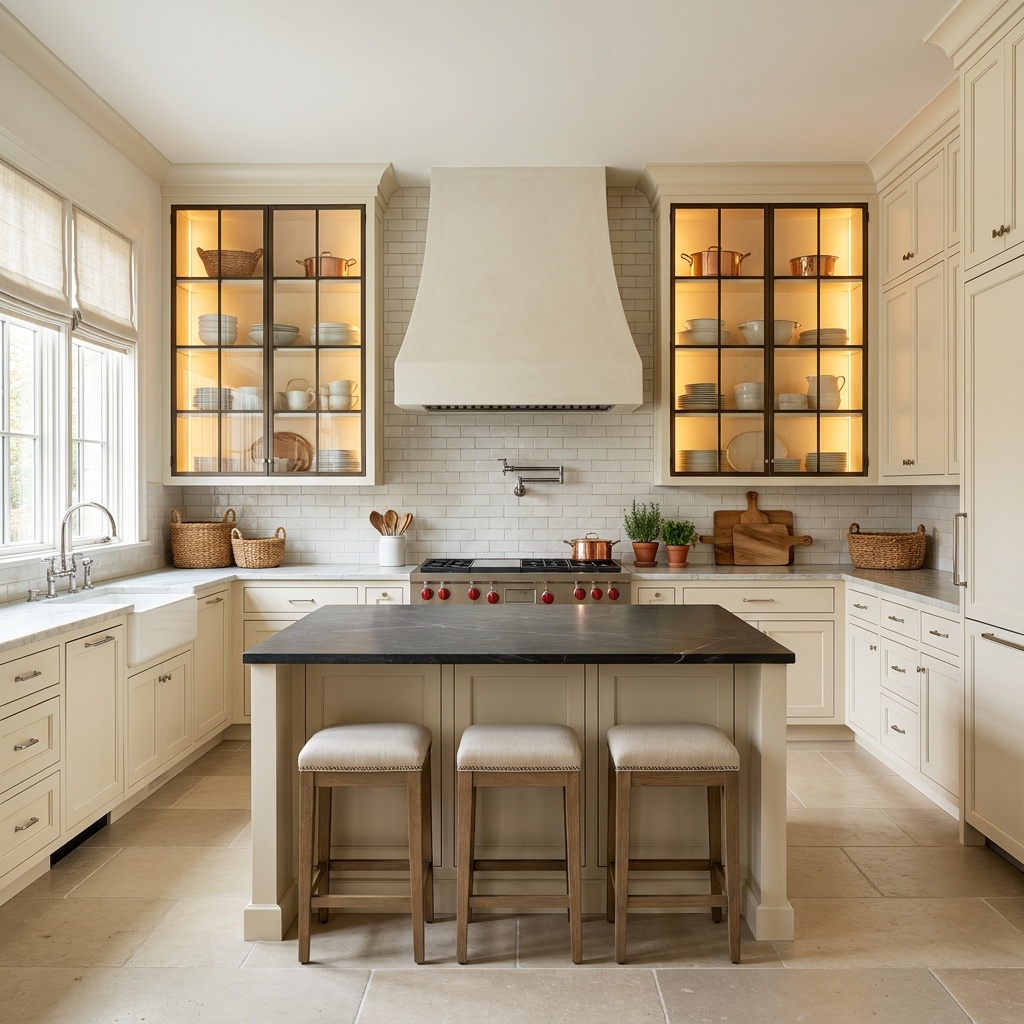
Four glasses cover almost every kitchen cabinet: clear, seeded, reeded or fluted, and frosted. They differ mainly in how much they hide. Clear hides nothing and commits you to keeping that cabinet styled. Seeded glass, made with deliberate air bubbles trapped in the sheet, softens the outlines of what is inside while leaving the contents readable. Reeded and fluted glass carries vertical ridges that break objects into stripes of color, concealing more than any other textured option while still passing full light. Frosted or satin-etched glass conceals completely, reducing a shelf of mismatched containers to a soft shadow. Most kitchens use glass on two to four doors rather than a whole run, and every glass door turns the inside of that cabinet into part of the room, so the interior finish, the shelves, and the light inside the box all become design decisions at the same moment the glass does.
The four glasses, side by side
All four pass light. What separates them is how much of the cabinet they give away.
| Clear | Seeded | Reeded / fluted | Frosted | |
|---|---|---|---|---|
| How much it hides | Nothing | A little | Most of it | Everything |
| What you see | The objects | Softened outlines | Vertical bands of color | A shadow |
| Reads as | Display case | Older, handmade | Current, architectural | Quiet, utilitarian |
| Best on | Curated dishware | Traditional, transitional | A feature pair or pantry door | Storage you would rather not see |
| Weak point | Demands permanent tidiness | Bubble density varies by supplier | Ridges must align door to door | Shows fingerprints |
Clear glass: a display case, and it behaves like one
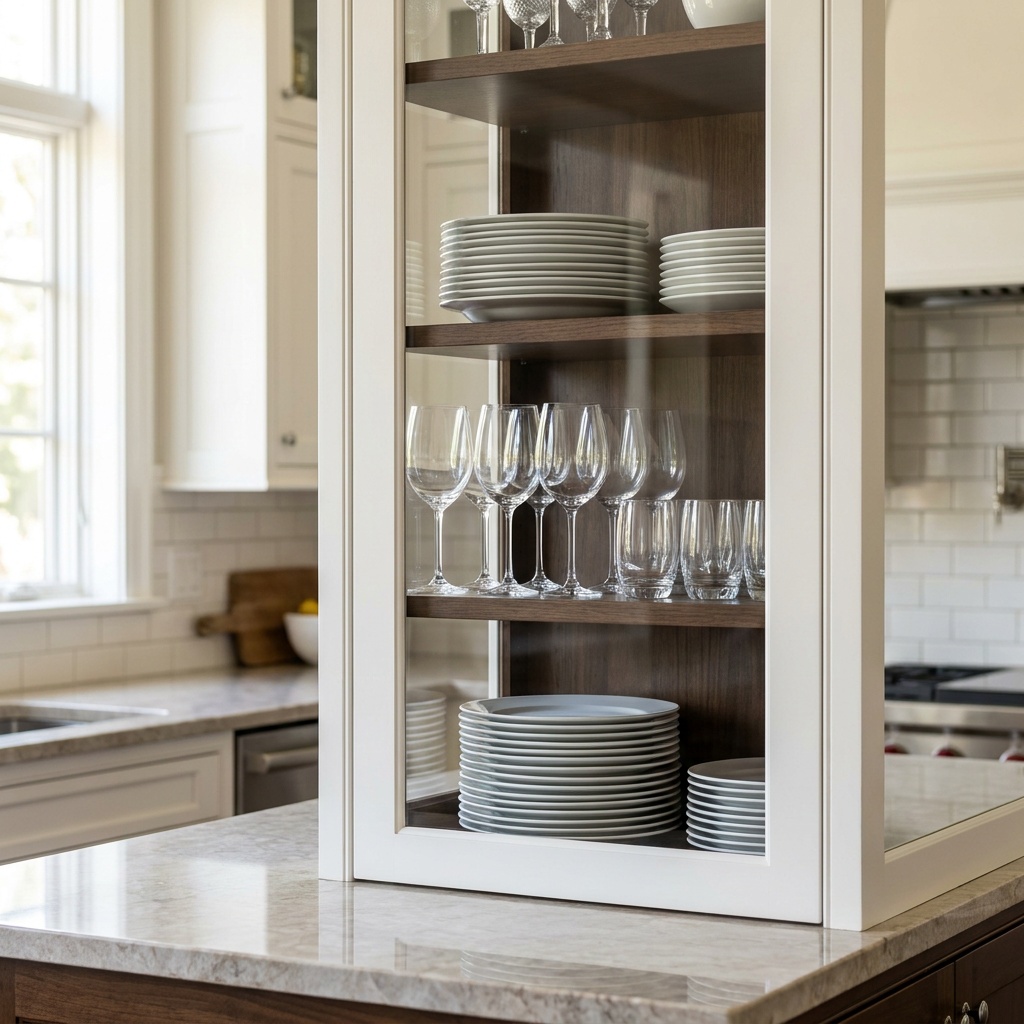
Clear glass is the honest option and the demanding one. Everything behind it is visible from across the room at all times, including the takeout containers someone shoved in during a rushed cleanup. If the answer to “will this cabinet stay curated” is anything but yes, choose one of the other three.
What it does well is hard to get another way: the eye travels past the door plane instead of stopping at it, which gives a wall of cabinetry depth. The rule that makes it look styled rather than stocked is repetition. Groups of the same object in the same color read as intentional; five different things on a shelf read as storage.
Seeded glass: texture without a commitment
Seeded glass has small air bubbles suspended in the sheet, a nod to old hand-blown glass where the bubbles were an accident of the process. They scatter light in a way that blurs edges and gives the pane visible surface life at an angle. You can still tell what is behind it; you just cannot read the label.
Bubble size and density vary a great deal between suppliers, so the sample matters more here than on any other glass. Fine, sparse seeding reads from six feet away as slightly imperfect clear glass, while heavy restoration-style seeding is a distinct texture that carries a room on its own. Ask to see a piece large enough to judge, held up with something behind it.
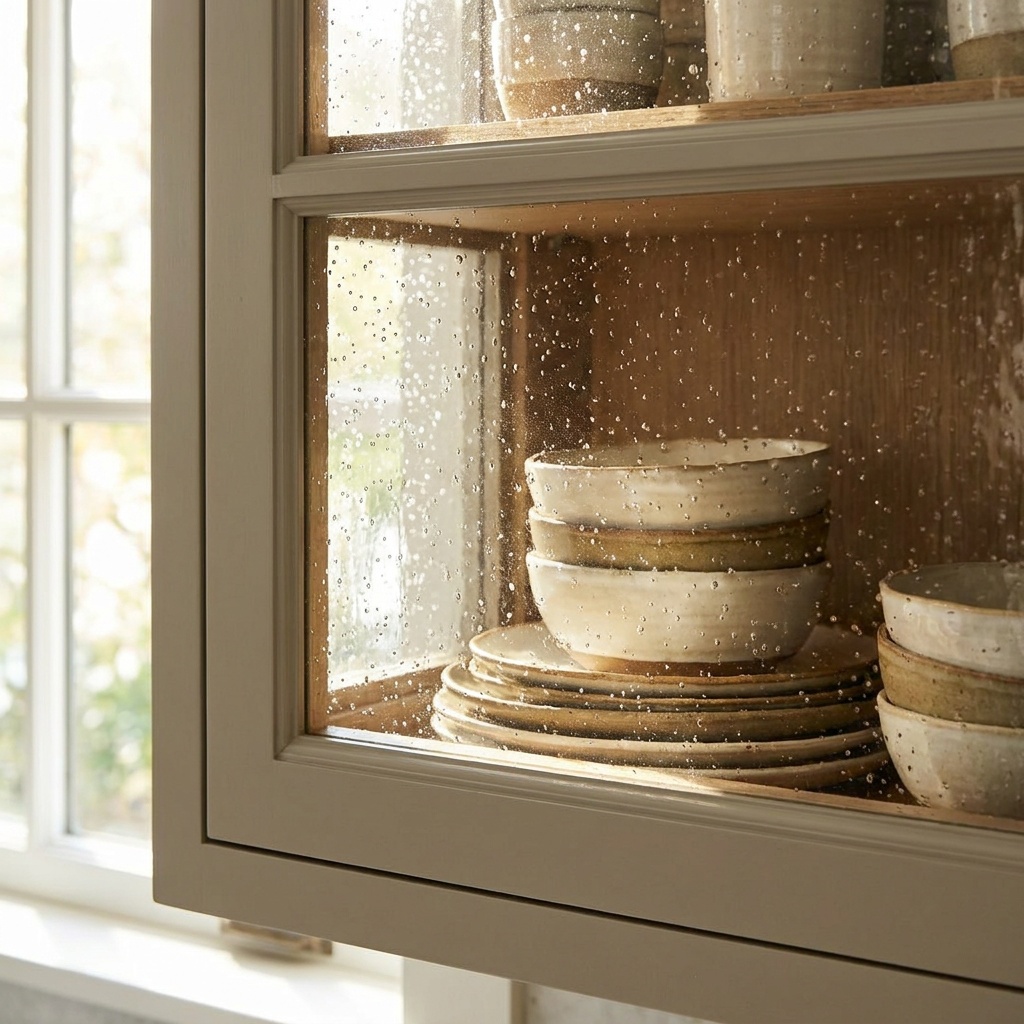
Seeded glass sits naturally with inset doors, mullion grids, and cabinetry with traditional bones. It is the wrong texture for a strictly modern kitchen, where its imperfection reads as inconsistency rather than choice. In a warm transitional kitchen, especially one built on the warm ivory and creamy neutral palettes that replaced gray, it is the least risky glass here.
Reeded and fluted: the vertical line everyone is asking for
This is the texture driving most of the current interest in glass cabinets, and it is where the vocabulary gets confusing. In millwork the distinction is real: flutes are concave grooves cut into a surface, reeds are convex ribs standing proud of it, which is why a fluted column and a reeded table leg look different. In glass, fabricators and cabinet shops use reeded, fluted, and ribbed more or less interchangeably for the same vertically textured sheet, ridged on one face and flat on the other. So do not shop by the name. Shop by three things instead.
- Pitch is the spacing between ridges. A narrow pitch, around half an inch or less, breaks the view into more and thinner bands and conceals more. A wider pitch closer to an inch gives a bolder rhythm and gives away more of what is inside.
- Depth is how far the ridge stands out of the flat. A deep profile throws real shadow and refracts light down each ridge; a shallow one is closer to a ripple.
- Orientation is which way the ridges run. Vertical is the default and reads as height, which is what most upper cabinets want. Horizontal is a deliberate statement and needs to run across a full section of cabinetry to look like a decision rather than a mistake.
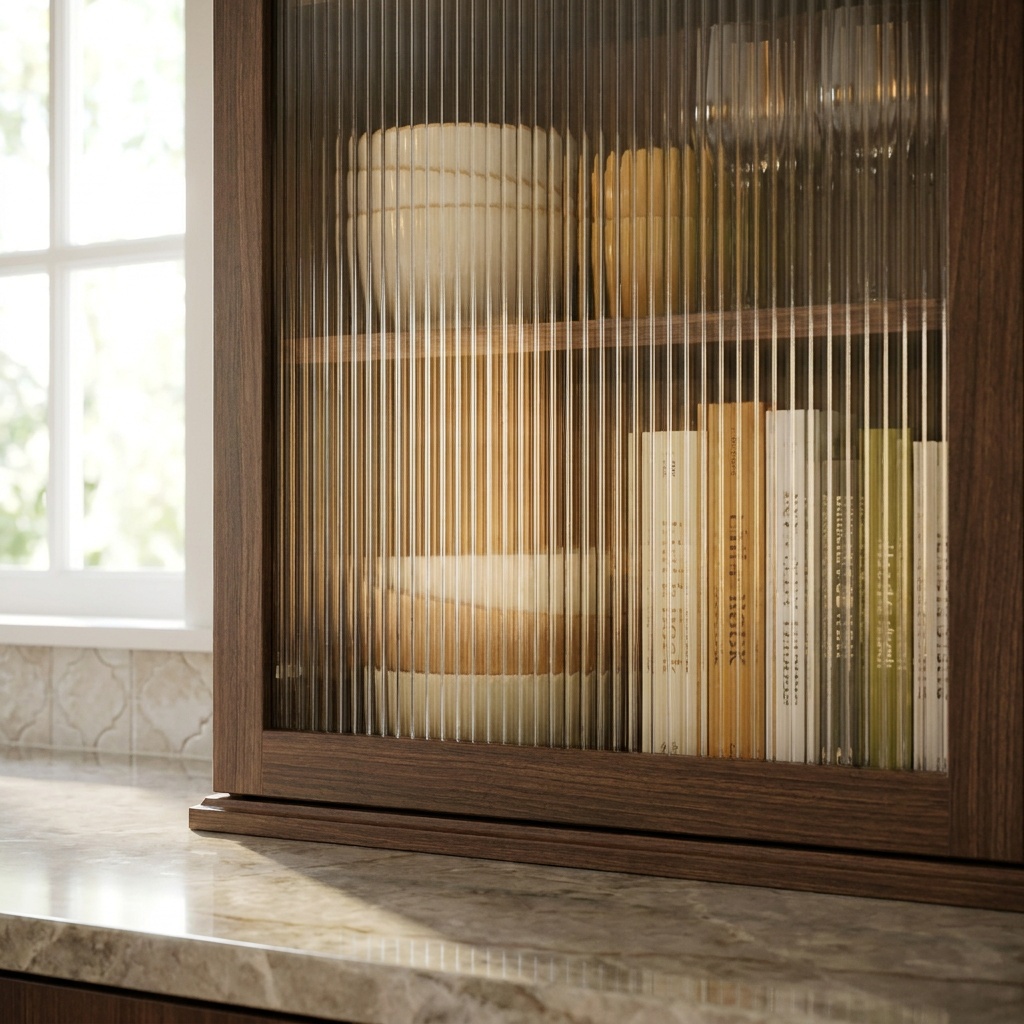
Two details separate reeded glass that looks custom from reeded glass that looks approximate. The first is alignment: on a pair of doors meeting in the middle, ridge spacing should carry across the gap without a visible stutter, which means cutting the glass with the pattern registered rather than from a random point on the sheet. The second is which face points out. Ridges facing into the room throw the deepest shadow but collect dust and cooking film in every valley; ridges facing in leave a flat, wipeable surface. Near a range, flat-out is the better trade.
Frosted and satin-etched: the quiet one
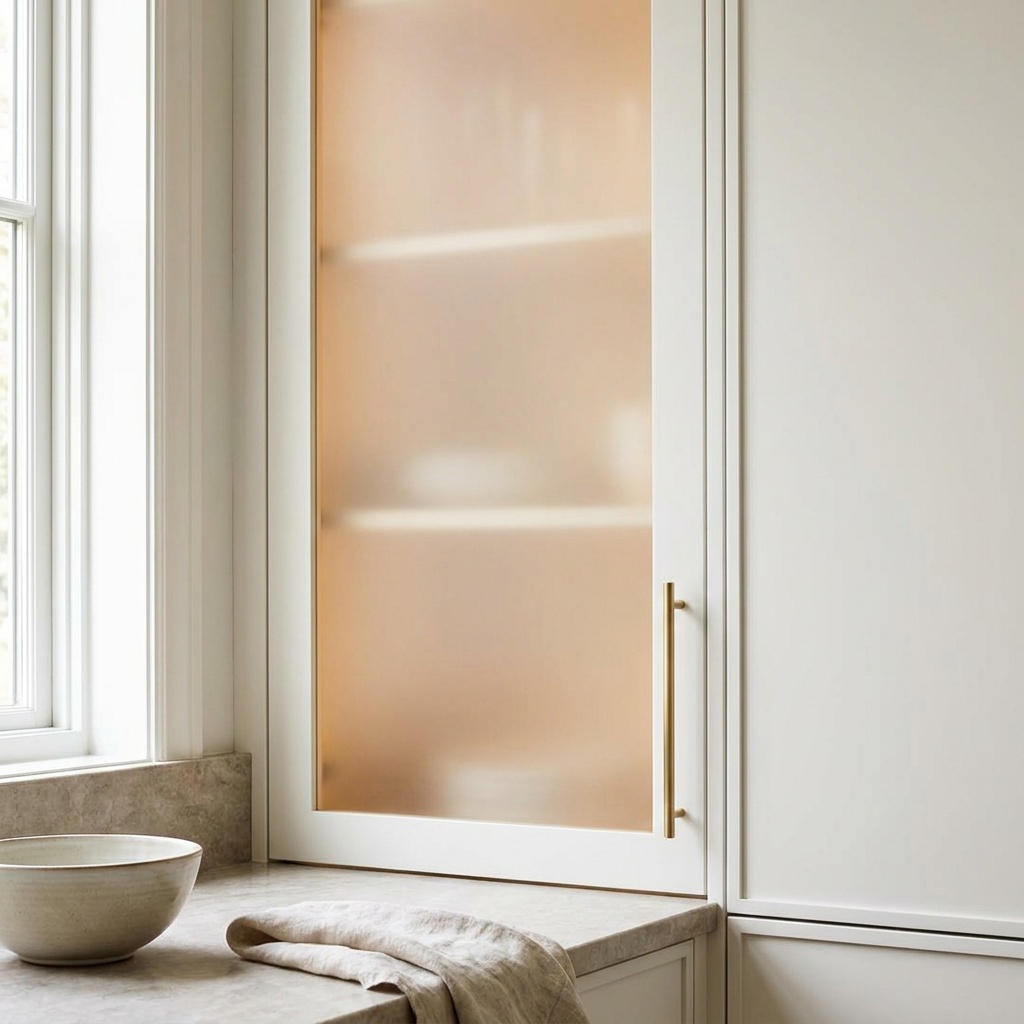
Frosted glass hides the contents entirely and still passes light, which makes it the simplest answer when the honest goal is to break up a wall of solid doors without displaying anything. It suits a tall pantry door, a bathroom cabinet, or the uppers above a coffee station. Of the two finishes, acid-etched produces a smooth matte surface that resists fingerprints reasonably well, while sandblasted glass has a more open texture that holds oils from hands. For a kitchen, specify acid-etched.
Mullions set the era more than the glass does
The grid across the front changes the character of a glass door more than the glass behind it. A single full-height lite is the modern reading. A two-by-three grid of small square panes is traditional, especially on an inset door. A perimeter grid, divided only around the outer edge, is the craftsman move. Arched and diamond patterns date a kitchen to whenever they went in.
True divided lites use separate panes with real wood muntins between them and look correct from every angle, at the cost of much slower cleaning. Applied grids lay an overlay on one continuous pane, clean in a single pass, and at normal viewing distance are hard to fault. On reeded and fluted glass, skip the grid: the ridges already supply the linear rhythm.
Where glass belongs in the plan
Glass is a punctuation mark, not a paragraph. A whole wall of it removes the calm a run of solid doors provides and multiplies how much interior has to stay presentable. Two to four glass doors is the range that reads deliberate. What tends to work:
- Flanking the hood. A matched pair on either side of the range hood is symmetrical, and symmetry is what makes that wall read as designed. Reeded glass earns its place here, hiding contents in the line of cooking splatter.
- The end cabinet of a run. A single glass door where cabinetry turns a corner gives the run a terminus instead of letting it just stop.
- Above a coffee station. The cups and glasses there are already a matched set, which solves the styling problem before it starts, and it pairs with the outlets a coffee bar needs anyway.
- A tall pantry door. Reeded or frosted at full height is one of the few places a single glass element carries a whole wall.
What usually disappoints: the cabinet directly beside the range, where grease films the glass faster than anyone wants to clean it, and base cabinets, where the sightline is downward and the contents are heavy, deep, and rarely photogenic.
What has to change behind the glass
This gets skipped constantly, and it is the difference between a glass cabinet that looks finished and one that looks like a solid cabinet with the door removed.
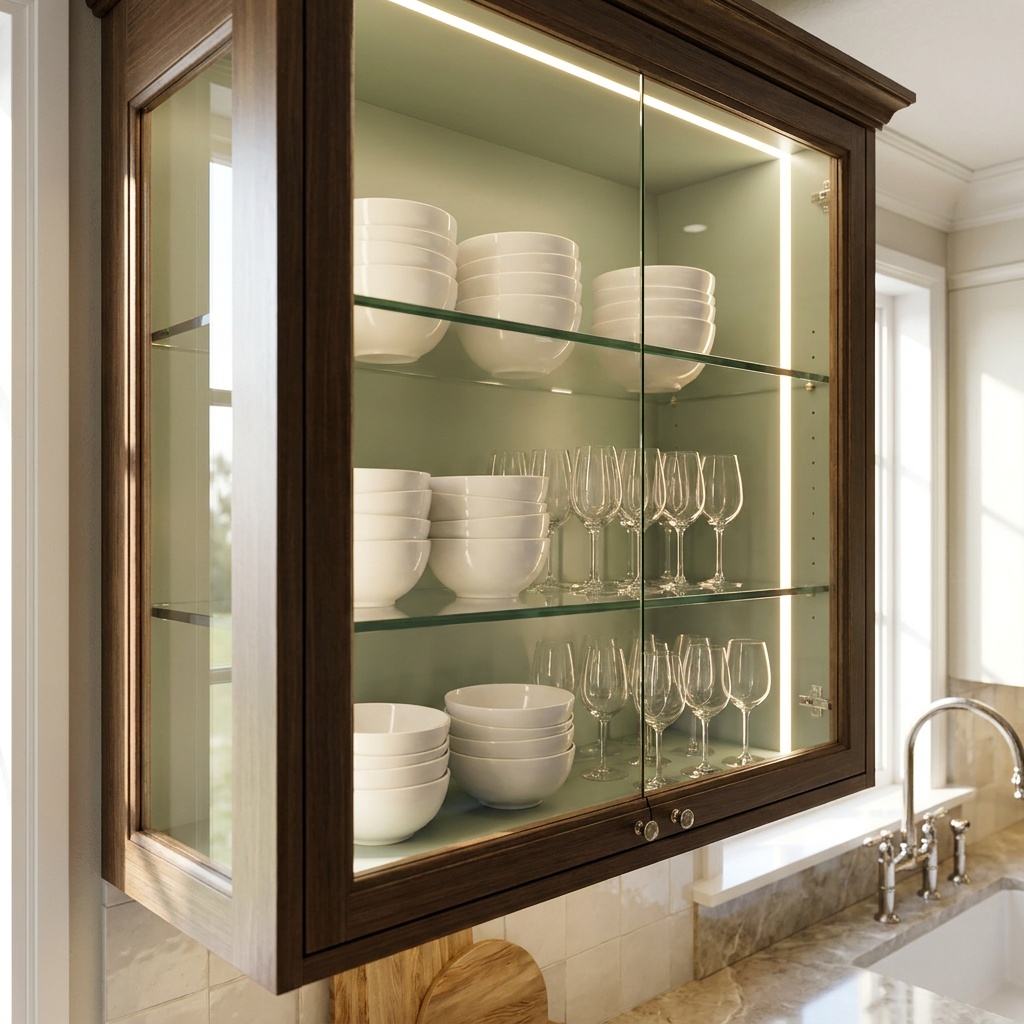
The interior gets finished. Standard cabinet interiors are melamine or plain veneer meant never to be seen. Behind glass, the box needs paint, either matching the door color for a seamless look or a deeper contrasting shade so pale ceramics stand out against it. A soft green, a deep blue, or a warm clay behind ivory cabinetry is one of the easiest ways to make a kitchen look designed. The same applies when repainting existing cabinetry: any box getting a glass door has to be prepped and sprayed as carefully as the fronts.
Shelves change material. Wood shelves block light, so a fixture at the top of the box lights only the top shelf. Glass shelves let light fall all the way down and make the box feel deeper. Specify a polished or pencil edge; a raw cut edge is visible through the door.
The box gets its own light, wired early. Unlit glass cabinets go dead at night, which is when the kitchen is most on display. Run LED tape in a shallow inverted U along the inside front edge, so the source hides behind the door frame and the light washes back across every shelf. Match the color temperature to the rest of the kitchen and give the cabinets their own switch, on the same logic as the under-cabinet lighting below. Power has to reach the back of the box before drywall closes, which illustrates what actually drives the price of a kitchen project: the decision is nearly free on paper and considerably less so once the wall is finished.
Retrofits have limits. A frame-and-panel door such as a shaker can be routed out and reglazed with retainer molding; a slab door has no frame to work with. Specify tempered glass for anything within a child’s reach and for any glass shelf carrying weight, and plan on new hinges, because glass doors are heavy enough to make tired hardware sag.
Frequently asked questions
Which type of glass hides clutter best in kitchen cabinets?
Frosted or satin-etched glass hides the most, concealing contents entirely while still passing light. Reeded and fluted glass is next, breaking objects into vertical bands of color so shapes are unreadable at normal distance. Seeded glass hides the least of the textured options, softening outlines while leaving contents recognizable. Clear glass hides nothing at all. If a cabinet holds packaged food or mismatched containers, choose frosted or reeded rather than relying on the household staying tidy.
What is the difference between reeded and fluted glass?
In millwork the terms are precise: flutes are concave grooves cut into a surface, and reeds are convex ribs standing proud of it. In glass, fabricators and cabinet shops use reeded, fluted, and ribbed more or less interchangeably for the same vertically textured sheet, typically ridged on one face and flat on the other. Rather than choosing by name, compare samples on three points: the pitch between ridges, the depth of the profile, and which face will point into the room.
Should reeded glass ridges run vertically or horizontally?
Vertical is the default and suits nearly every upper cabinet, because the ridges emphasize height and echo the lines already in the cabinet stiles and door frames. Horizontal is a deliberate statement that needs to run across an entire section of cabinetry to look intentional; on a single door among vertical neighbors it reads as an error. Either way, ridge spacing should align across adjacent doors so the pattern carries through the gap without a visible step.
How many glass cabinet doors should a kitchen have?
Two to four is the range that reads deliberate in most kitchens. Glass works as punctuation against a field of solid doors, and a full wall of it removes that contrast while multiplying how much cabinet interior has to stay presentable. The strongest placements are a symmetrical pair flanking the range hood, the end cabinet where a run terminates, the uppers above a coffee station, and a single tall pantry door. Avoid glass on base cabinets and beside a range.
Working out where glass belongs in a kitchen in Alpharetta, Roswell, or anywhere across North Atlanta? Book a design consultation and we will plan the glass, the interiors, and the lighting together, or call 404-640-2361.