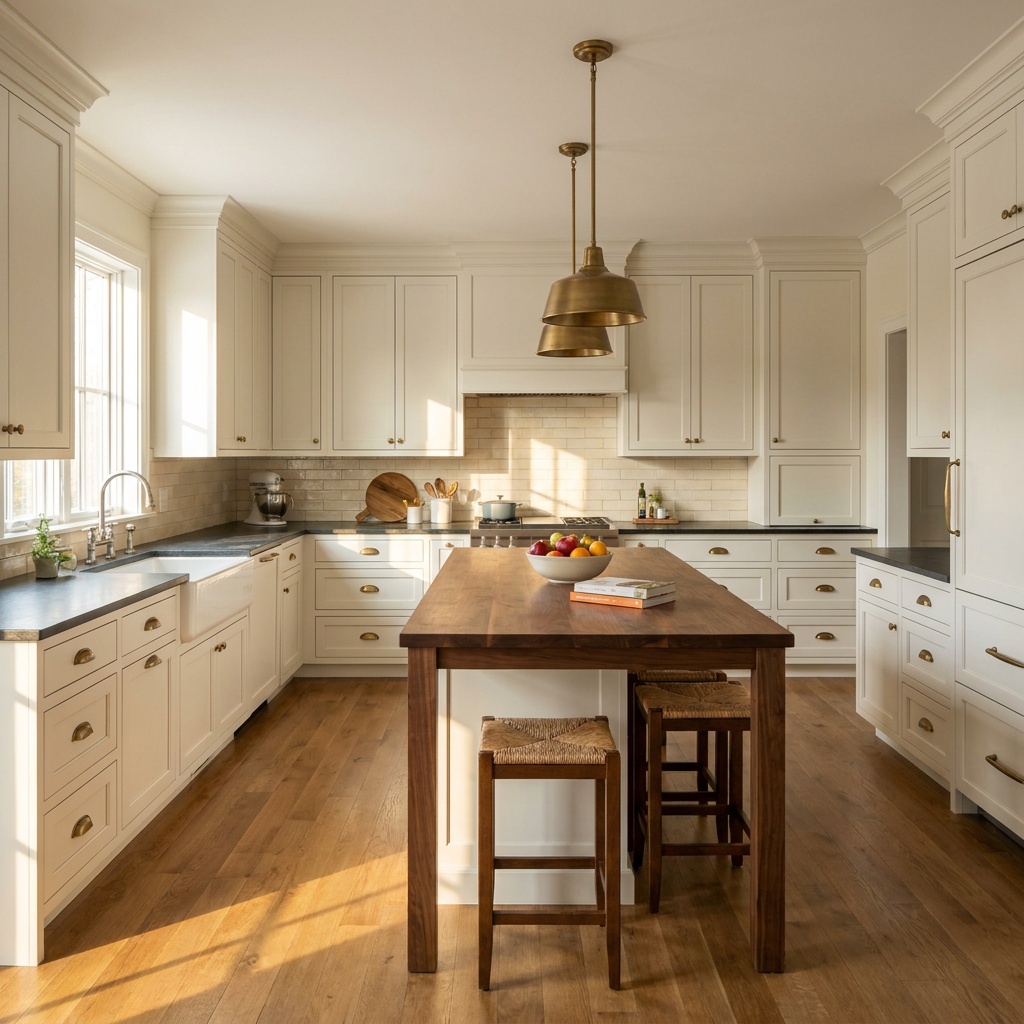
Soapstone, porcelain and butcher block solve three different problems. Soapstone is a talc-rich stone at roughly 2 to 2.5 on the Mohs hardness scale, so it takes knife marks and dents readily — and gives them back, because 220-grit followed by 400-grit sandpaper erases a scratch in a way no harder stone allows. It is non-porous, never needs sealing, and takes a pan straight off the burner. Porcelain is a fired clay-and-mineral slab, usually 12mm thick in a kitchen, effectively stain-proof, heat-tolerant and UV-stable — but that thin profile means the substantial edge you see is a mitered fold, and it chips where thick stone would shrug off the hit. Butcher block is wood: warm underhand, sandable, and the only one of the three that moves with the season and needs a finish schedule. Pick soapstone for a surface that records your kitchen, porcelain for one that refuses to, and wood for warmth on a run that stays dry.
How the three compare
| Soapstone | Porcelain | Butcher block | |
|---|---|---|---|
| Hardness | Mohs 2–2.5; scratches and dents | Very hard face, brittle at the edge | Soft; cuts, dings and dents with use |
| Heat | Excellent; hot pans straight onto it | Very good; no scorching or discoloration | Poor; scorches and stresses glue lines |
| Stains and sealing | Non-porous, never sealed, acid-proof | Non-porous, never sealed | Porous; the finish is the only barrier |
| How it ages | Darkens to charcoal, collects a patina | Looks identical in year ten | Mellows and darkens; marks accumulate |
| Repairs | Sand the area, re-oil, done | Chips need a color-matched fill by a pro | Sand and refinish, in place |
| Edge look | Any profile, cut from full thickness | Mitered to fake thickness; few profiles | Any profile; end grain shows at the ends |
| Where it belongs | Perimeter or island in a cook’s kitchen | Range wall, backsplash runs, sunlit rooms | Island or baking zone, away from water |
Soapstone: the surface designed to change
Soapstone has been in American kitchens since the nineteenth century, and in chemistry labs, for one reason: nothing you spill on it matters. It is chemically inert and dense enough that liquids do not penetrate, so the lemon halves and vinegar that etch a pale ring into marble leave it as they found it. No sealer, ever.
Slabs sold for countertops run roughly 40 to 60 percent talc — soft enough that a dropped pot leaves a dent and a knife leaves a line. The trade is deliberate. Take 220-grit paper to the mark, follow with 400, wipe on food-grade mineral oil, and the repair vanishes into the surrounding stone. A scratch in quartzite is a fabricator’s visit; a scratch in soapstone is twenty minutes on a Saturday.
Oiling is a choice, not maintenance. Dry soapstone is a soft blue-grey; oil pulls it to deep charcoal and makes the white and green veining leap forward. Most owners oil monthly for the first year and a few times a year after that, then stop, because the stone has darkened on its own. Skip the oil and it still darkens, only unevenly: dark where hands and water travel, lighter at the edges. Those are two different-looking countertops from the same slab.
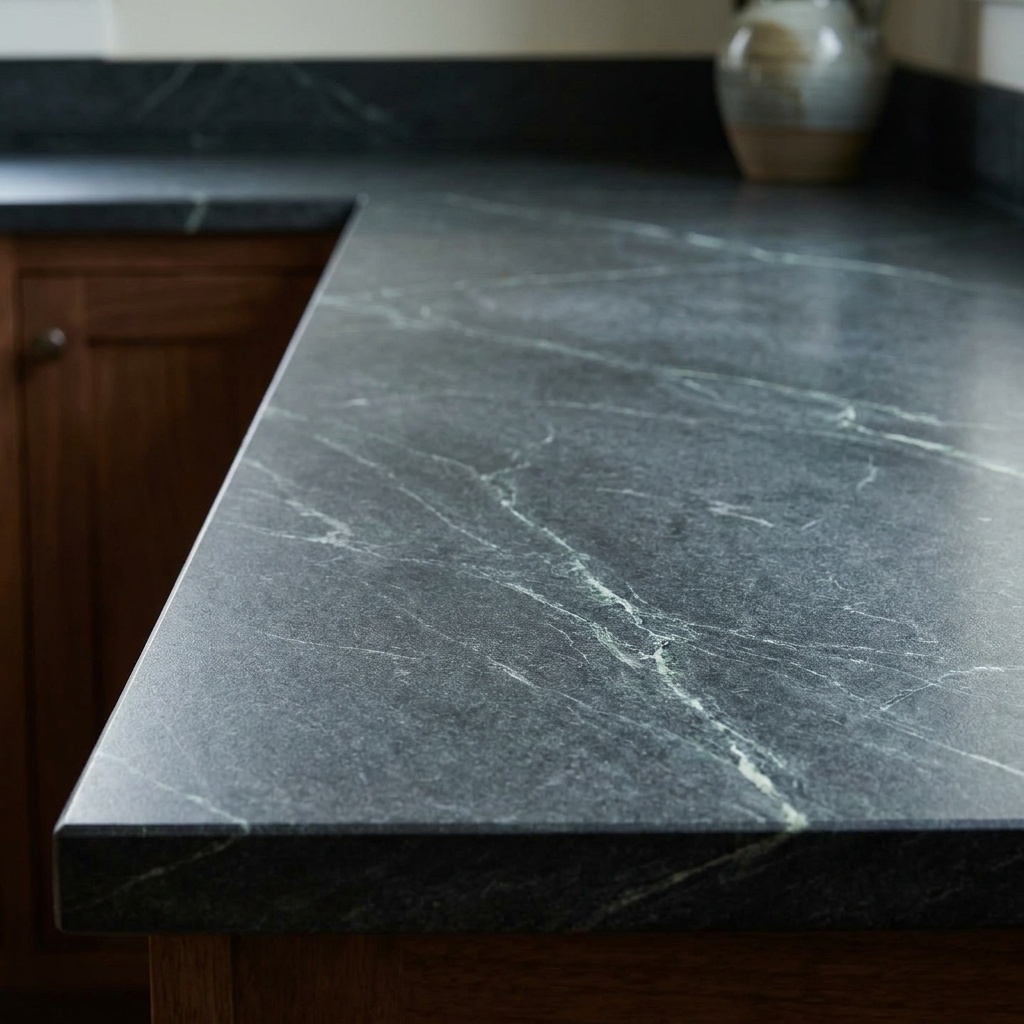
One planning note: soapstone slabs run smaller than granite or quartzite, so a long island or an uninterrupted perimeter is more likely to need a seam, placed at the sink or a corner. In exchange, the stone is cut from full thickness, so the edge profiles are real — an eased square, a chamfer, a subtle bullnose — with no glue line in them.
Porcelain: the surface designed not to
Porcelain slab is the newest of the three and the least understood. Clay and mineral powder pressed under enormous force and fired produces a sheet that absorbs almost no water, does not fade in direct sun, and shrugs off heat, acid and abrasion. Slabs come large, commonly around 126 by 63 inches, so the counter, a full-height backsplash and an island face can all be cut from one pattern run.
Thickness is where porcelain parts company with everything else. Residential slabs are typically 6mm or 12mm — roughly a quarter to a half inch, far thinner than the 3cm stone most people picture. To get the substantial edge a kitchen expects, the fabricator cuts a 45-degree miter and folds a strip of the same slab underneath, creating a hollow edge with an adhesive joint running the length of the counter. Done well it is invisible; done poorly, or on cabinetry that later settles, the miter is the first thing to show.
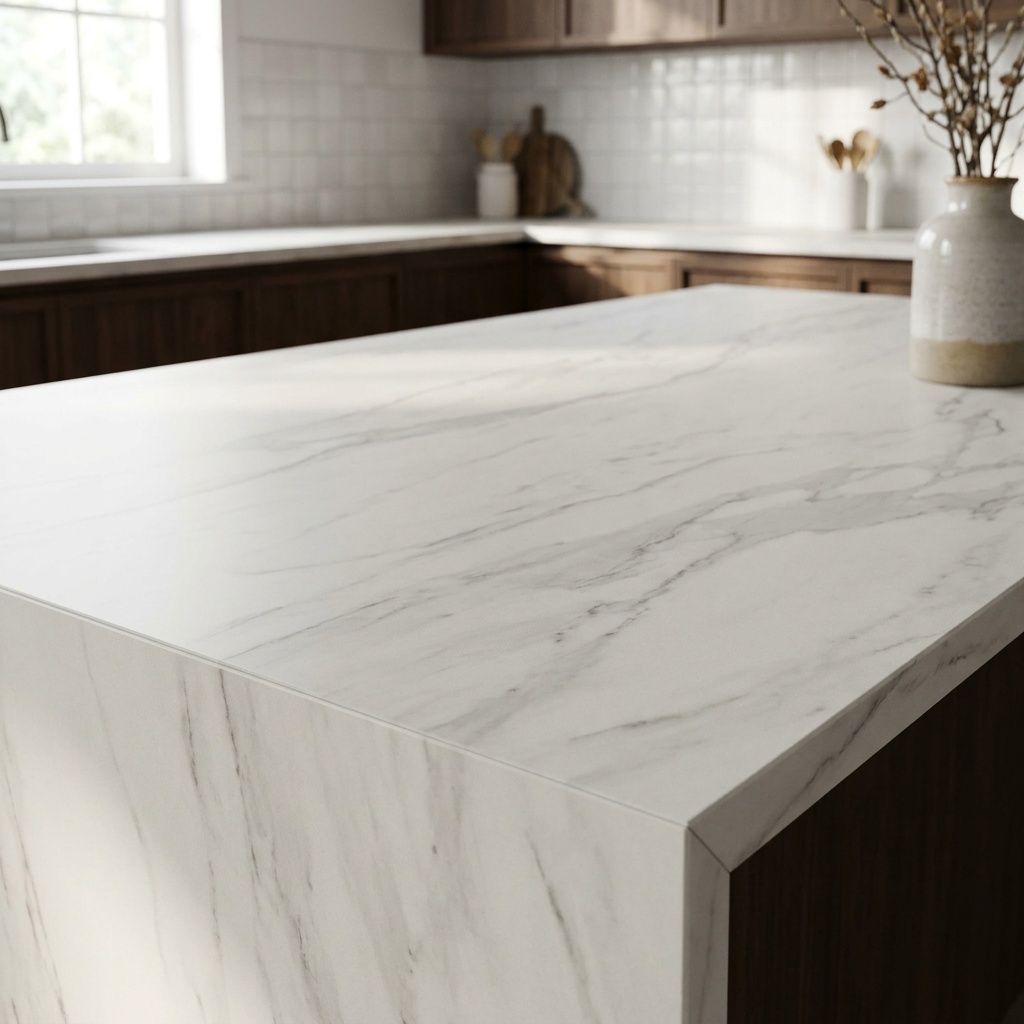
Ask one question at the showroom that most buyers never think to ask: is the pattern full-body, or printed on the face? On many porcelain products the veining is a surface layer, so a mitered edge, a sink cutout or a drilled faucet hole exposes a paler core. Full-body slabs carry the pattern through the thickness and cut cleanly anywhere — a difference invisible on a sample chip and obvious on a finished counter.
The other caution is impact. Hardness and toughness are not the same thing: the face is nearly unmarkable, but a cast-iron pan clipping a corner can take a chip out, and the fix is a color-matched fill by a specialist rather than something sanded away. Fabrication matters more here than with any other surface, and undermount sinks need support built into the cabinet, so ask to see a finished kitchen the shop has cut.
Butcher block: warmth on a schedule
Wood absorbs sound and light where stone reflects both, it is forgiving on dropped glassware, and it is the one countertop a homeowner can restore completely with a sander. Species sets the character: hard maple is tight, pale and dense enough for daily knife work, walnut is darker and hides marks maple shows, and white oak matches the rift-sawn cabinetry turning up in so many kitchens now. Edge grain, where the strips lie on their sides, is the standard for a countertop and the most stable; end grain, the checkerboard, closes up around a knife edge but is thicker, heavier and moves more with humidity.
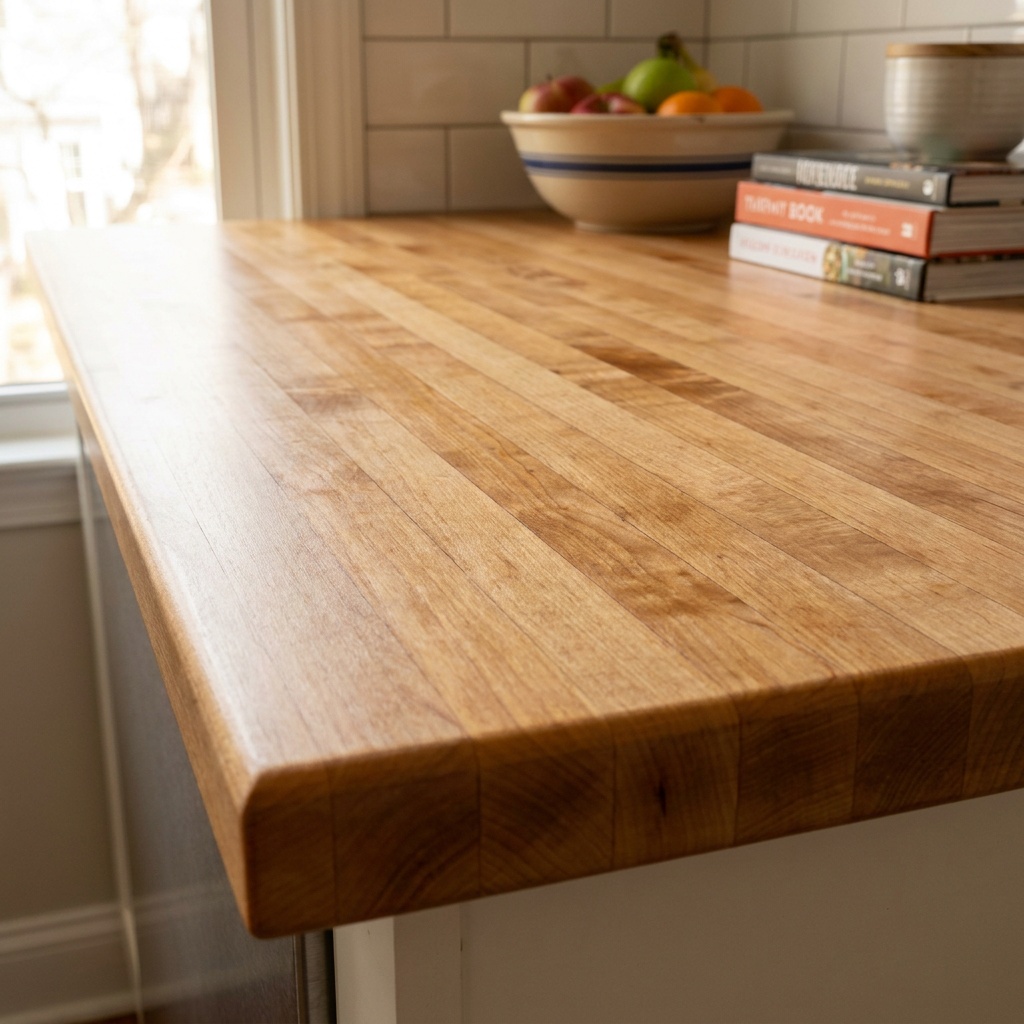
Then the finish, which is the whole ballgame. Penetrating mineral oil is food-safe and endlessly renewable, but offers no water barrier — fine on a baking island, a poor choice where water pools. Hardwax and tung-oil blends build a thin film, resist water noticeably better, and can be repaired one section at a time. A food-safe varnish or acrylic protects best around a sink, with the trade that when it fails it fails in a patch you have to sand back and recoat.
Georgia’s climate is the other planning factor. Wood expands across its width in humid summers and contracts in a heated winter house, and a top screwed down tight will crack rather than move. Fasten it through elongated slots or figure-eight fasteners, never glue it to the cabinets, and hold it a hair off the wall at each end.
Mixing surfaces in one kitchen
None of these has to take the whole kitchen, and the best versions usually do not. A soapstone island against quartz perimeter counters gives you the dark, oiled focal point without asking every square foot to tolerate scratches. Porcelain on the range wall, run up as a full-height backsplash, puts the heat-proof material where the heat is. A butcher block section at the end of a run gives the room warmth without putting wood beside the dishwasher.
Two rules keep a mixed kitchen from looking accidental. Let one material carry the room and the second act as the accent, and carry something across the boundary — the same edge profile, the same undertone — so the change reads as deliberate. If you are weighing these against the mainstream surfaces, our quartz, quartzite and granite comparison covers the rest of the market, and the sink belongs in the same decision, since sink material and mounting style depend on what the top is made of.
Which one belongs in your kitchen
Choose soapstone if you cook seriously and find a surface that records its own history appealing rather than alarming. Choose porcelain if the kitchen takes hard afternoon sun, if a continuous stone-look backsplash is part of the design, or if a countertop that looks identical in a decade is the point. Choose butcher block for a defined zone where warmth matters more than waterproofing. The wrong pick is usually a mismatch of temperament rather than a bad material: soapstone in a household upset by the first knife mark is a long argument with a countertop.
Common questions
Is soapstone too soft for a kitchen countertop?
It is soft, at roughly 2 to 2.5 on the Mohs scale, and it will pick up knife marks and dents from dropped pans. Whether that is a problem depends on your tolerance for a surface that shows use. The counterweight is that soapstone is the only common countertop stone a homeowner can repair: 220-grit then 400-grit sandpaper removes a scratch, and mineral oil blends the repair into the surrounding stone. Households that want a countertop to look untouched in ten years are better served by quartzite or porcelain.
Do porcelain countertops chip easily?
The face is extremely hard and resists scratching, staining and heat, but the edges are the vulnerable point, particularly on 6mm and 12mm slabs where a mitered edge creates a thin corner. A heavy pan striking that corner or the edge of a sink cutout can take a chip out, and unlike soapstone or wood, the repair is a color-matched fill done by a specialist rather than something you sand away. Clean miters, proper cabinet support and reinforced sink cutouts reduce the risk considerably.
Can you put a butcher block countertop around a sink?
Yes, but it changes the finish requirement. Mineral oil is not enough where water pools; the run needs a film finish such as a food-safe varnish or acrylic, with the cutout edges and underside sealed as thoroughly as the top. A drop-in sink with a good rim gasket protects the cut edge better than an undermount, and some wood countertop makers exclude oiled tops with sink cutouts from their warranty. The lowest-risk plan keeps wood on a run with no sink.
Do soapstone countertops have to be oiled?
No. Oiling is cosmetic, not protective, since soapstone is non-porous and needs no sealer at any point in its life. Mineral oil simply accelerates and evens out a darkening that happens anyway. Oil it and the stone goes deep charcoal immediately, with the veining standing out. Leave it alone and it darkens gradually and unevenly, dark where hands and water travel. Most owners oil monthly for the first year, a few times a year afterward, then stop.
Which is better for a family kitchen, soapstone or porcelain?
Porcelain, if the goal is a surface that survives children, homework and heavy traffic without showing it. Nothing stains it, sunlight does not fade it, and it needs no maintenance beyond wiping. Soapstone suits a family that cooks constantly and reads marks as character rather than damage, since hot pans, spills and acidic foods are non-issues and scratches sand out. The deciding question is not durability but which kind of aging your household is comfortable living with.
Planning your countertops
Countertops are decided at the slab yard, not from a sample chip. Soapstone and porcelain both look meaningfully different at full size, and wood species shift once a finish goes on. See the whole slab, ask how the seams and the miter will fall, and ask what the fabricator has cut before. Our Alpharetta kitchen remodel guide explains how material choices shape the rest of a project, our main page shows the work we do across North Atlanta, and in the older homes around Milton one of these surfaces on an island with a quieter perimeter material is often the version that holds up best.
When you are ready to see these materials in your own light, book a design consultation and we will bring samples to the kitchen and map the seams before anything is ordered. You can also call 404-640-2361.